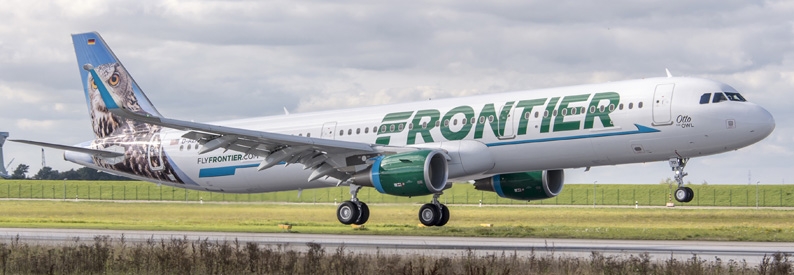
FRONTIER AIRLINES TO CUT FLEET AND DEFER DELIVERIES
On 11 February 2026, Frontier Airlines announced its performance over 2025. Last year, the airline posted a loss of $137 million and because of that the airline is launching on a cost cutting drive that impacts the fleet and orders.
First, it reached an agreement with Airbus to defer the delivery of 69 A320neo-family aircraft on order. Originally, they were planned for delivery between 2027 and 2030. Now, they have been pushed back to 2031-2033.
Second, Frontier has agreed with lessor AerCap the early termination of the lease of 24 A320neos. The leases of these Airbuses was supposed to expire between 2028 and 2034 but will now start to leave the fleet later this year.
According to Frontier's CEO, these measures will generate a annual cost-saving of $200 million and ensure the airline can continue to grow more moderate.
Today, the airline's fleet is made-up of six A320s, 91 A321neos, 21 A321s, and 60 A321neos. It has unfilled orders with Airbus for twelve A320neos and 148 A321neos.
Over the last few weeks, three major US low-cost carriers have announced that they are deferring deliveries of new Airbus A320neo-family aircraft. They are doing this to reduce capital expenditure in the coming years, the expectation of lower passenger demand, as well as issues with the new engines.
On 1 July 2024, Spirit Airlines was the first to announce that they have deferred all new Airbuses it had planned to take delivery of between July 2025 and December 2026 until 2030 and 2031. How many aircraft are exactly involved hasn't been communicated. The airline currently has open orders for 23 A320neos and 30 A321neos.
JetBlue announced on 30 July 2024 that it has agreed with Airbus to defer 44 A321neos to 2030 onwards. The airline will not take delivery of any new Airbus between 2026 and 2029. JetBlue has open orders with Airbus for 49 A321neos. The delivery of new A220-300s will continue, of which they still have 66 on order.
The last airline to announce a deferral is Frontier Airlines, which did so on 8 August 2024. In total, the airline is deferring 54 A320neos and A321neos which it planned to take delivery of between 2025 and 2028. Instead, they now plan to take them on from 2029 onwards. Next to the deferral, Frontier Airlines also said it has decided to swap orders for eighteen A321XLRs into regular A320neos. The low-cost carrier currently has open orders with Airbus for 49 A320neos and 147 A321neos.
On 11 October 2022, Frontier Airlines welcomed its first Airbus A321neo in the fleet with a special ceremony at Tampa-International Airport (FL). The aircraft, A321-200NX N903FR (11032) is featuring a special "America's Green Airline"-livery and featurs a bald eagle on the tail. It had already arrived at the airport on 1 October after delivery from Hamburg-Finkenwerder.
The A321-200NX is the first of 176 A321neos the airline has on order, consisting of 158 A321-200NXs (A321neoLR) and eighteen A321-200NYs (A321neoXLR). Today, Frontier Airlines also operates fourteen A320s, 80 A320neos and 21 A321s.
US-based Frontier operates nineteen A320ceo, seventy-three A320neo (with 58 on order), and twenty-one A321ceo. It also has sixty-seven A321neo and eighteen A321neo(XLR)s on order.
Chile-based JetSMART operates six A320ceo and eight A320neo (with 56 due) with orders for seven A321neo and twelve A321neo(XLR)s. JetSMART Argentina (WJ, Buenos Aires Ezeiza) operates five A320ceo.
Frontier Airlines Retires Its Smallest Aircraft Type: The A319
The Airbus A319 has reached the end of the line at Frontier Airlines. On Wednesday, the airline officially retired its last Airbus A319 with a special send-off from Nashville. The end of Airbus A319 operations comes as Frontier focuses on the Airbus A320neo family of aircraft that offers improved fuel efficiencies and better economics.
Frontier Airlines has officially retired its Airbus A319s. Photo: Frontier Airlines
Frontier Airlines retires its final Airbus A319
Frontier flight 391 from Nashville International Airport (BNA) to Denver International Airport (DEN) was a special one. This was the final flight ever of an Airbus A319 in Frontier’s fleet. According to data from RadarBox.com, the flight on Wednesday took two hours and 22 minutes.
Daniel Shurz, senior vice president of commercial at Frontier Airlines, stated the following:
“The retirement of Frontier’s last Airbus A319 aircraft is a proud and symbolic moment for our team as we look ahead towards a greener future. Our ultra-modern fleet is already the most fuel-efficient in the U.S. skies and, as we continue the transition to A320neo (New Engine Option) and A321neo aircraft, our fuel savings and operational efficiencies continue to evolve.”
The final flight was a memorable one for passengers and crew. Photo: Frontier Airlines
Passengers on the final flight were made aware of the special occasion via an onboard announcement. There were also giveaway items, including a frameable certificate commemorating the occasion. Denver-based Frontier crew members were also invited to greet the aircraft on arrival at a gate celebration in Denver.
The final Airbus A319 in Frontier’s fleet bore the registration N949FR. It was originally delivered to the airline in 2006, making it 15 years old. Frontier’s aircraft are known for featuring animals on the tail. This aircraft featured Erma the Ermine.
Erma the Ermine was Frontier’s final A319. Photo: Frontier Airlines
The Airbus A319s were the smallest aircraft in Frontier’s fleet in 2021. The jets had room for 150 passengers. Now, the airline is moving to the Airbus A320neo family of jets, which seat 180 passengers at the lower end in Frontier’s fleet. At the upper end are the Airbus A321s.
With this upgauging, Frontier Airlines is not worried about having too large aircraft for its markets. On the airline’s first-quarter earnings call, Mr. Shurz was asked about the carrier’s retirement of the A319s and whether it would limit its ability to fly to smaller destinations. He stated the following:
“As we go to a lot higher gauge, we get lower costs, and we already have a strategy of applying the right frequency to the right market … We fly our smaller markets, in general, today on the A320neo which is the bulk of our fleet today – the majority of our fleet today, and we found that works.
“We fly some small markets at low frequency on the A321 and find that works. We have the lowest cost, we are going to be a low cost leader, and that enables us to fly as many markets as we can, and I think that’s the right strategy to maximize our opportunity.”
Frontier Airlines is betting on the Airbus A320neo. Photo: Airbus
Frontier Airlines has no plans to fly the next generation of the A319, the A319neo. The carrier has instead placed its bets on the A320neo, A321neo, and the A321XLR. With these higher-gauge aircraft, Frontier gets lower unit costs, which can make them incredibly economical. Plus, given the carrier’s dense layout, the A321XLR will enable the airline to bring its services to more destinations.
Not the smallest Airbus jet ever in Frontier’s fleet
Before the Airbus A319, Frontier’s smallest aircraft was the Airbus A318. The smallest variant of the A320ceo family, these aircraft did not garner huge orders, but Frontier Airlines flew 11 of the type, according to data from ch-aviation.com.
The aircraft was officially retired from Frontier’s fleet in 2013. The carrier took its first A318 in 2003, but deliveries continued until 2007. Since then, A318s have become harder to find in the sky. Now, Frontier Airlines has put its name down as the next airline retiring smaller aircraft in favor of upgauging the network and leveraging lower-cost, newer, fuel-efficient aircraft to support its low fares.
Frontier Airlines (F9, Denver Int'l) has said in its quarterly financial report that it recently signed commitments with two lessors to add ten A321-200s with deliveries scheduled from the second half of 2022 to early 2023.
"[The A321s] work in big markets, they work in small markets, they bring lower unit cost. The marginal costs on the extra seats is very low. We believe we can successfully deploy the additional A321s in almost every airport in our system. There are a few airports where, operationally, we have to use A320. But, broadly speaking, the A321 can fly almost everywhere in our system and as a mix of our fleet continues to move towards the A321, you’ll see us deploying it system-wide," Senior Vice-President (Commercial) Daniel Shurz said during the quarterly earnings call.
According to the ch-aviation fleets advanced module, Frontier Airlines currently operates three A319-100s, nineteen A320-200s, sixty-nine A320-200Ns, and twenty-one A321-200s. It has a further sixty-two A320-200Ns, as well as sixty-seven A321-200Ns, and eighteen A321-200NX(XLR)s on order from Airbus. It plans to take five A320-200Ns during the remainder of 2021. The deliveries of the A321neo will begin in 2022 with the first five units of the type due to arrive that year alongside nine A320neo. The carrier has an option to convert 18 orders for A320neo into A321-200NX(LR)s.
Frontier Airlines has thus far refrained from adding second-hand aircraft - all of its aircraft, except for two ex-Monarch Airlines A320-200s - were delivered directly from the manufacturer.
Frontier Airlines Airbus A320 Overshoots The Runway At DCA
Last night, a Frontier Airlines Airbus A320 overshot the runway at Ronald Reagan Washington National Airport after flying in from Denver International Airport. The narrowbody was left sitting on the grass for approximately an hour before passengers were transported to the airport’s building by buses.
The Frontier Airlines Airbus A320-200 has been with the airline for a decade. Photo: Vincenzo Pace | Simple Flying
Late-night drama
According to RadarBox.com, Flight F9538 left Denver, Colorado at 17:13 MDT before arriving in the Washington D.C. area at 22:18 EDT. However, there was more than a bumpy landing.
The Daily Mail reports that passengers noticed a few shakes then experienced a significant swerve before ending up off the runway. Thus, the wheels of the aircraft were left stuck in the grass.
At approximately 10:30pm Friday, Frontier Airlines flight 538, arriving at Reagan National Airport (DCA) from Denver (DEN) and operated on an Airbus A320, landed safely before coming to a stop in a grassy area off the end of Runway 1,” Metropolitan Washington Airports Authority shared, as reported by the Daily Mail.
“There are no reported injuries, and passengers will be deplaned from the aircraft via stairs and bused to the terminal. Runway 1/19 has been temporarily closed to air traffic while airport crews assess the situation, and Runway 15/33 is open.”
The Frontier Airlines passengers were delayed following the unexpected incident. Photo: Getty Images
No reported injuries
According to ch-aviation, registration N213FR, the A320-200 involved in this weekend’s incident, arrived at Frontier’s facilities in May 2011. The aircraft can hold 150 passengers in economy and 30 in economy plus. Thankfully, there were are no reported injuries to the guests and crew members on board following this event. Nonetheless, emergency vehicles were deployed soon after.
Buses arrived at 23:30 local time to help the 151 passengers on the plane make their way to the terminal, where they would be provided with further assistance and be reunited with their luggage.
Frontier has also since confirmed to Simple Flying that the aircraft came to a stop “slightly beyond the runway upon landing.” The low-cost carrier added that safety is the airline’s foremost priority and that an investigation has been launched to find out more about the occurrence in the D.C.-area.
Across the industry
This event isn’t the only overrun event that happened this week. An Ethiopian Airlines Boeing 777 was also stuck in the mud after skidding off the runway at Lagos Airport in Nigeria. This sort of event is not extremely rare. Last month, we reported on an Antonov AN-124 overrunning the runway at Sao Paulo-Guarulhos. Carriers will undoubtedly be keen to eradicate these instances to avoid any potential danger.
Frontier Airlines Accelerates Airbus A319 Retirements
Frontier Airlines is accelerating the retirements of its older and smaller Airbus A319s. Initially scheduled to depart the fleet by the end of 2021, Frontier will remove those aircraft early in favor of the Airbus A320neo aircraft. The final Airbus A319 will now depart a few months early, in the third quarter of 2021.
Frontier will retire all of its Airbus A319s this year. Photo: Getty Images
Frontier Airlines accelerates Airbus A319 retirements
On the airline’s first-quarter earnings call, Frontier Airlines Chief Financial Officer, James Dempsey, stated the following:
“In early May, we executed a contract with one of our lessors to accelerate the return of four remaining A319 aircraft from the company’s fleet. Three of the A319 aircraft will exit Frontier’s please during the second quarter of 2021, and the fourth aircraft will exit the fleet in the third quarter of 2021. This is the completion of an early objective of the transformation of Frontier into an ultra-low-cost carrier by replacing all A319 aircraft with larger and more fuel efficient A320 and A321 aircraft.”
Previously, Frontier Airlines had planned to retire all four in December of 2021. Over the last few years, as Frontier transitioned to an ultra-low-cost carrier, it sought to use higher gauge aircraft that lowered the carrier’s costs. As a result, the Airbus A319 fleet started to make its exit.
Frontier’s Airbus A319s
Frontier Airlines only has four Airbus A319ceos in its fleet. Since 2013, these planes have been exiting the carrier’s fleet. In fact, the final four aircraft received a retirement plan in 2018. In December of 2018, Frontier completed a sale-and-leaseback agreement on these four jets, with retirement dates scheduled in December 2021.
Stay informed: Sign up for our daily and weekly aviation news digests.
Over the years, Frontier has sought to increase the density of its aircraft. On the Airbus A319ceos, this meant going from 138 seats to 150 seats. These planes are currently the smallest jets in terms of passenger capacity in the airline’s fleet. In the past, the airline has flown smaller jets, including the Airbus A318.
No impact on the route network
When asked on the earnings call about whether A319 retirements would preclude the airline’s ability to fly into smaller markets, Senior Vice President – Commercial, Daniel Shurz stated the following:
“As we go to a lot higher gauge, we get lower costs, and we already have a strategy of applying the right frequency to the right market… We fly our smaller markets, in general, today on the A320neo which is the bulk of our fleet today – the majority of our fleet today, and we found that works. We fly some small markets at low frequency on the A321 and find that works. We have the lowest cost, we are going to be a low cost leader, and that enables us to fly as many markets as we can, and I think that’s the right strategy to maximize our opportunity.”
The Airbus A320neo will provide Frontier Airlines a cost-savings. So, the carrier can charge lower fares to fill up the incremental capacity the Airbus A320neo offers without needing to sell tickets well below cost.
In general, ultra-low-cost carriers are moving away from small, A319-sized aircraft. Spirit Airlines has retained its Airbus A319s – for now – while Allegiant focuses its growth around the Airbus A320. On the Boeing side, airlines like Sun Country are focusing on the Boeing 737-800s. The Airbus A320 and Boeing 737-800s can, at the high side, seat around 180 passengers in a dense, single-class layout. Moreover, there are even greater prospects with the 737 MAX.
As a larger and newer aircraft, Frontier will realize cost savings on the Airbus A320neo that it will, hopefully, be able to pass off to consumers with low, unbundled fares.
Frontier Airlines Will Retire All Of Its Airbus A319s In 2021
American ultra-low-cost carrier (ULCC), Frontier Airlines, has announced that it will retire all of its Airbus A319ceos this year. The smallest aircraft in Frontier’s fleet, these planes will depart as Frontier continues to take additional Airbus A320neo family of jets that are more fuel-efficient and provide cost savings over the A319.
Frontier Airlines will retire all of its Airbus A319s this year. Photo: Getty Images
Frontier Airlines plans Airbus A319 retirements
Frontier Airlines has been removing its Airbus A319s from service as it takes its newer and fuel-efficient Airbus A320neos. At the end of 2020, the airline had a fleet of 104 aircraft. Only four of those jets were Airbus A319ceos.
The Airbus A319 fleet has been reduced steadily since 2013. The final four aircraft that the airline still has in its fleet are not owned by the airline. In December 2018, Frontier completed a sale-and-leaseback agreement covering four Airbus A319ceo aircraft.
The leases on these four Airbus A319s will expire in December 2021. When 2022 starts, the airline will exclusively operate Airbus A320ceos, A320neos, A321ceos, and A321neos. This will allow Frontier to significantly reduce its average fleet age as the Airbus A319s were the oldest jets in Frontier’s fleet.
Frontier’s Airbus A319s
In 2013, Indigo Partners acquired Frontier Airlines and reshaped it into a well-known ultra-low-cost carrier with exceptionally low costs. In 2015, the airline began to increase its capacity on its planes.
Frontier Airlines increased the density of its Airbus A319ceos. Photo: Getty Images
On the Airbus A319ceos, the airline increased the density of the jets from 138 seats to 150 seats. The Airbus A320ceos also received densification, going from 168 seats to 180 seats.
The Airbus A319s were not the smallest aircraft to be in Frontier’s fleet. The airline previously flew Airbus A318s under the mainline service. Later, the airline ended up signing an agreement to outsource Embraer E170 aircraft operations for regional flying. Both of those aircraft were later dropped.
The Airbus A319s are mostly based out of Denver. These aircraft fly some of the smaller routes for Frontier, including out to El Paso in Texas and Bozeman in Montana.
Frontier’s fleet plans
As a ULCC, the airline is big on keeping its costs down. The airline does this by maintaining an efficient fleet of one family: the Airbus A320 family. With the A320neo family, Frontier can move forward with its fleet efficiency goals without compromising on its single fleet type.
For Frontier, the Airbus A320neo family of aircraft is the future. Photo: Frontier Airlines
The airline had commitments to purchase 156 Airbus A320neo family aircraft. Those are all due through the end of 2028. The new A320neo and A321neos will replace the A319ceos with larger gauge aircraft that are cheaper to operate. The A320neos seat 186 passengers, and the A321neos seat 240 passengers.
These larger-gauge aircraft have lower unit costs than the A319ceos. Frontier Airlines seeks to stimulate demand with low airfares, and filling up larger jets should be a little easier if Frontier can charge lower fares. The airline’s real test is on ancillary fees and whether it can extract a premium after gaining the attention of passengers with its low base fares.
Frontier Airlines Takes Delivery Of Its 100th Airbus A320
Frontier has celebrated a new milestone that few airlines reach, accepting delivery of its 100th aircraft. Yesterday the airline received its new Airbus A320neo, painted with a very distinct ‘Chinook the Gray Wolf’ livery.
The livery of the 100th Frontier aircraft. Photo: Frontier Airlines
Reaching 100 aircraft
Few airlines grow to reach a hundred airframes, let alone one hundred of the same family aircraft (which in Frontier’s case is the Airbus A320 family).
“Taking delivery of the 100th Airbus aircraft in our fleet marks a tremendous milestone for our company,” said Barry Biffle, CEO of Frontier Airlines in a press statement. “We have significantly expanded our fleet in recent years as Frontier has continued to grow both domestically and internationally,”
Frontiers’ order book with Airbus is staggering, with another 88 Airbus A320s, 30 A321neos, and 18 A321XLRs set to be delivered over the next half a decade.
“Airbus is pleased to reach this significant 100th aircraft milestone with Frontier Airlines, and to be a part of the airline’s continuing growth and success,” said C. Jeffrey Knittel, Chairman, and CEO, Airbus Americas, Inc. “With 160 more aircraft on order, we look forward to many more of these milestones.”
Looking at these numbers, while getting to a hundred aircraft was a long journey in the making, the next hundred will pass by very soon. It is more likely the carrier will run out of animals to paint on its tails than aircraft.
This 100th aircraft has a livery of a famous wolf called Chinook. Chinook was a wolf-dog hybrid set to be put down in 1993 for fear of her wolf genes, but she was saved at the last minute. Rescuing this animal had far-reaching consequences, such as dismantling the dangerous label of wolf-dogs and creating the Colorado Wolf and Wildlife Center, hence why she deserves her spot on the tail.
The new aircraft takes off for its first revenue route. Photo: Frontier Airlines
Why has Frontier been so successful?
Many ask why Frontier has been able to reach 100 aircraft in a market with peers like United, Delta, American, and Southwest (all of whom have over 100 short-haul planes). This is because of its unique business model – ultra-low-cost flights.
Onboard a Frontier aircraft, everything is for sale, and nothing is provided with your airfare. While its typical for you to pay for luggage or seat selection onboard United or American Airlines, onboard Frontier, you need to pay for cabin bags, and a table tray isn’t always included.
Where Frontier Airlines flies. Source: Frontier Airlines
Thus, while the fares may at first be cheap, when you add in luggage and other fees (like paying with a credit card), the cost can skyrocket. But since customers are already committed to the ‘cheap fare’, they push onwards and book.
This business model has rewarded the airline and today it wizzes across the country and to select international destinations. With new aircraft on the way with extreme range (like the Airbus A321XLR), Frontier might turn its hungry eyes to the lucrative transatlantic trade and offer destinations to Europe. A win for passengers indeed.