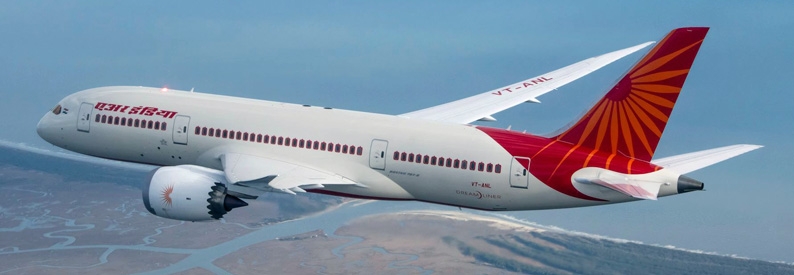
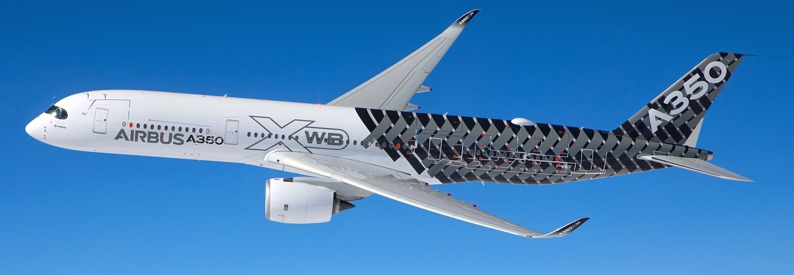
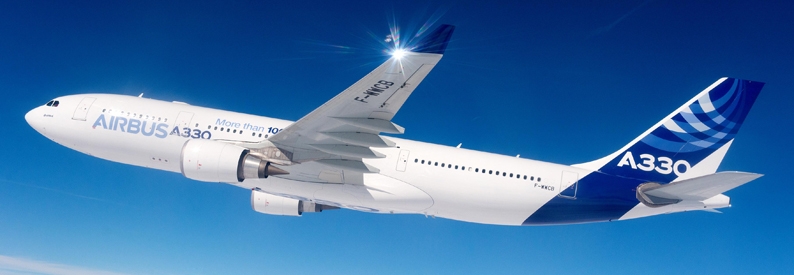
Air India Takes Delivery of its First Airbus A350-900
On 23 December 2023, Air India unpacked a nice Christmas-present in the form of taking delivery of its first Airbus A350. The A350-900, registered VT-JRA (554) was welcomed with a traditional water salute at Delhi after completing its delivery flight from Toulouse-Blagnac.
The aircraft is the first of six A350-900s the airline will take delivery of until March 2024. These six A350-900s were originally destined for Aeroflot and the cabins have received slight modifications to reflect the Air India-brand. They will be outfitted with 28 Business Class, 24 Premium Economy, and 264 Economy Class seats. Air India will start deployment of its first A350 in the coming weeks, initially serving domestic and short international destinations in order for the crew to get familiarized with the type.
Originally, Air India ordered six A350-900s and 34 A350-1000s but recently announced a change to its order. It has now reconfigured its A350-order into orders for 20 A350-900s and 20 A350-1000s.
The delivery of its A350 marks the first step of the renewal and expansion process of Air India's widebody-fleet. Next to the Airbuses, this will also be done by its order of 20 Boeing B787-9s and ten B777-9s.
Newly privatised Air India (AI, Mumbai Int'l) has decided to procure its first batch of A350 widebodies, with anonymous sources informing the Press Trust of India that first delivery is likely by March 2023. At the same time, reports have emerged that the carrier is considering ordering up to 300 narrowbody jets.
Air India has not bought a single aircraft since 2006, when it acquired 111 including 68 from Boeing and 43 from Airbus. Although the exact model or quantity of the A350s being ordered was not specified to the news agency, the sources said that the aim is to improve the quality and efficiency of services on long-haul routes such as to the United States.
The now Tata Sons-owned airline is looking to order around twenty A350s, people close to the matter told Bloomberg News, one option being to take jets that had previously been intended for Aeroflot (SU, Moscow Sheremetyevo) and can no longer be delivered due to sanctions. Another potential fast track would be to acquire aircraft that Qatar Airways (QR, Doha Hamad Int'l) is not currently taking due to a clash with Airbus over A350-1000 paint quality.
Air India has asked its pilots to respond by June 20 on whether they want to undergo “conversion training” to fly the A350, according to a letter to senior cockpit crew seen by Bloomberg.
Unnamed sources told Bloomberg in February that Air India had been in talks with both Airbus and Boeing as well as lessors about potential orders for new aircraft to rejuvenate its ageing fleet.
Air India did not immediately respond to ch-aviation’s request for comment, while Airbus commented: “We are always in contact with existing and potential customers and the nature of these discussions - whether happening or not - are confidential.”
On June 20, Bloomberg reported anonymous sources as telling it that Air India is also considering an order for up to 300 narrowbody jets. The order would be for A320neo Family aircraft or B737 MAX or a combination of both. Production and delivery could take more than a decade to complete
Following intense diplomatic pressure, Colombo Commercial High Court in Sri Lanka suspended on June 6 an order preventing an Aeroflot (SU, Moscow Sheremetyevo) flight from leaving the country. The order was suspended after a judge, who had arrested the widebody four days previously, considered an emergency motion filed by the Attorney General of Sri Lanka.
Judge Harsha Setunga had denied Airbus A330-300 RA-73702 (msn 1301) - or VQ-BMY as it was known until being forcibly transferred to the Russian register on April 15 - permission to return to Moscow Sheremetyevo from Colombo Int'l as scheduled on June 2 with around 200 passengers on board. However, Flightradar24 ADS-B data shows that Flight SU569 departed Colombo bound for Moscow at 1821L (1251Z) on June 6.
Celestial Aviation Trading Limited, an affiliate of lessor AerCap, had sought to confiscate the aircraft after the relationship between lessor and airline collapsed in the wake of tough Western sanctions imposed after the Kremlin-ordered invasion of Ukraine. It is one of around 750 foreign-owned aircraft in Russia that have been transferred to the local registry.
Since the seizure, Russia’s Foreign Ministry has demanded that Sri Lanka resolve the situation, warning that it could damage bilateral relations at a time when the vulnerable Asian country faces economic collapse. The island has been a popular destination for Russian holidaymakers, but it is currently experiencing its worst economic crisis since independence in 1945.
Russia's Interfax news agency reported earlier on June 6 that the court was preparing to hear the case even though the next court session on the issue had been set for June 8. Sri Lanka's Foreign Ministry had told it that "the matter is still pending the final determination of the court. This matter is also under consultation through normal diplomatic channels."
On June 5, a spokesman from Sri Lankan Prime Minister Ranil Wickremesinghe's office told the country's Daily Mirror newspaper that the leader had informed Moscow that the issue was not between two countries but a private legal matter. However, the government's aviation minister had personally apologised to the affected passengers and crew and acknowledged that the matter was likely to impact the tourism industry in addition to Sri Lanka's ongoing foreign exchange crisis.
In Moscow, the Russian government had summoned the Sri Lankan ambassador for explanations, while in Colombo a group of Sri Lankans educated in Russia and those involved in the tourism industry had held a protest in front of the prime minister's office and then marched to the Russian Embassy to hand over a letter showing solidarity with Russia.
The A330-300 had arrived from Moscow earlier in the day at 1010L (0440Z), 40 minutes earlier than scheduled, but the Airbus widebody did not begin its return journey at the scheduled time of 1250L (0720Z), Flightradar24 ADS-B data shows.
An official representing the airport told the news agency Agence France Presse that it had been prevented from returning following an order from the Colombo Commercial High Court.
“Air traffic control received an order to hold Flight SU289,” the unnamed official said. “We are not aware of the reason, but we hear it is something to do with a commercial dispute.”
Sri Lankan Ambassador Janita Abeivikrema Liyanage was summoned to the Russian Foreign Ministry to explain her country's actions. Moscow subsequently called on Sri Lanka "to resolve this problem in a short time in order to avoid its negative impact on the two countries' traditionally friendly bilateral relations."
According to the ch-aviation fleets advanced module, the aircraft in question, A330-300 RA-73702 (msn 1301), was VQ-BMY until it was transferred to the Russian register on April 15. The majority state-owned flag carrier had operated the jet since April 2012. GECAS owns the aircraft and AerCap manages it.
It was one of around 750 foreign-owned aircraft in Russia that were forcibly re-registered in the country after their certificates of airworthiness were cancelled as part of tough Western sanctions imposed after the Kremlin-ordered invasion of Ukraine. The sanctions gave European and American lessors until March 28 to terminate lease contracts with Russian carriers, but they have refused to return the vast majority of the affected aircraft and airlines continue to operate many of them.
Aeroflot suspended all international flights in March, but despite a recommendation from Russia’s civil aviation regulator (Rosaviatsiya) for carriers not to fly foreign-leased aircraft abroad to avoid their possible seizure, the airline resumed operations to Colombo in April.
It has not been divulged whether the detention of Flight SU289 was related to the sanctions. However, Sri Lankan media reported that Judge Harsha Sethunga of the Colombo Commercial High Court had issued the injunction after hearing a complaint filed by Celestial Aviation Trading Limited in Ireland. According to online sources, Celestial is an Aercap affiliate. The enjoining order said that the A330 would be impounded until June 16.
A court hearing on the removal of the seizure was scheduled for June 8, an Aeroflot representative told Forbes Russia, adding that passengers and crew had disembarked and were being accommodated in hotels “according to the standards of the airline.”
Aeroflot, Russia’s biggest airline, has bought eight Airbus A330 aircraft from foreign leasing companies, the carrier said on Friday. According to the Russian operator, it bought these jetliners “as part of the fulfillment of contractual obligations.” Let’s investigate further.
Buying the aircraft
Since the beginning of Russia’s invasion of Ukraine, foreign leasing companies have been heavily impacted after being unable to recover their stranded planes in Russia. More than 400 aircraft leased from Western firms are currently grounded in Russia. The value of these planes is nearly US$10 billion.
On Friday, Aeroflot informed Reuters it had bought eight Airbus A330 aircraft from foreign leasing companies. Nonetheless, it did not specify which firms the planes had been leased from.
As reported by Reuters, the purchase could be a bid to maintain good relations with lessors.
There’s an exemption to European Union sanctions against Russia in respect of aircraft financial leases. This exemption involves purchase when the lease ends.
Looking at Aeroflot’s Airbus A330 fleet
Aeroflot has a fleet of 12 Airbus A330-300, according to data provided by ch-aviation. Eight of these planes are under a financial leasing contract and are owned by Vistavia Ireland DAC and Aviasky Ireland DAC.
A finance lease is where the aircraft is owned by the bank (or its special purpose company), and regular lease payments are made by the airline to the bank until the full amount is paid, and the airline owns or has the option of purchasing, the aircraft.
GECAS owns two additional A330-300s operated by Aeroflot, Goshawk one and AerCap another. The latter is the only one that does not have a Russian registration. Instead, it has a registration from Bermuda, VQ-BMV.
Overall, in Russia, there are 26 Airbus A330-300s, according to ch-aviation. The remaining planes are operated by iFly Airlines (seven) and Nordwind Airlines (seven). They are mostly leased to Western lessors, including GECAS, CDB Aviation, Carlyle Aviation Partners, and more. Nonetheless, iFly Airlines leases two from DAE Capital, a Dubai-based lessor.
The leasing companies are losing billions in assets currently frozen in Russia. To cope with the impact, leasing firms have initiated lengthy insurance claims to try to recover some of the lost value of the aircraft.
AerCap, the world’s biggest aircraft lessor, has submitted the most significant claim, a US$3.5 billion insurance claim for more than 100 jets.
According to Cirium, there were 515 commercial jets and turboprops leased to Russian airlines by non-Russian lessors at the start of the conflict. In late February, 39 of them were already outside of Russia and thus probably no longer on lease in Russia. Additionally, another 41 planes have been repossessed successfully since the conflict began.
Airbus (AIB, Toulouse Blagnac) is considering delaying its previously announced ramp-up in A350 production from five to six units per month until late 2023 amidst an ongoing dispute with Qatar Airways (QR, Doha Hamad Int'l) coupled with the impact of the Russian invasion of Ukraine, Bloomberg has reported, citing internal sources.
The European manufacturer originally planned to increase its A350 roll out rate in late 2022 but later deferred that to early 2023.
In a statement to Reuters, Airbus said it continued "to expect to increase the A350 production rate from around five per month to around six in early 2023".
sixteen A350-1000s ordered by IranAir (IR, Tehran Mehrabad), which is also subject to international sanctions, and
twenty-one A350-1000s ordered by Qatar Airways, which refused to take any more units of the type pending the resolution of the legal dispute over fuselage paint deterioration.
Heston Airlines (HST, Vilnius) has signed an agreement with Avolon for the lease of three A330-200s, with the first unit due for delivery by mid-August 2021 and all three to arrive by mid-October 2021.
ch-aviation understands the Lithuanian ACMI/charter specialist will add two aircraft in a makeshift freighter configuration with passenger seats removed at this time, while the third one will be outfitted with a standard passenger cabin.
Although the carrier did not disclose the aircraft's identity, ch-aviation research has revealed that they will be ex-Aeroflot stock - VQ-BBE (msn 1014), VQ-BBF (msn 1045), and VQ-BBG (msn 1047). The aircraft are between 12 and 12.2 years of age and were operated by the Russian flag carrier since delivery. They were retired between February and May 2021 and are currently undergoing maintenance and partial conversion at Hong Kong Int'l airport.
Airbus Delivered 50 Aircraft In May While Taking 7 New Orders
Airbus today released its order and delivery figures for the month of May. The number of deliveries was up from April for a total of 50, with the majority represented by A320 and A321neos. Meanwhile, the planemaker giant only received seven new orders. The majority of those, perhaps somewhat unexpectedly, were instead represented by the A350.
JetBlue took delivery of its third A220 in May. Photo: Airbus
Total of 220 deliveries for 2021
From May 1st to 31st, Airbus delivered 50 planes 32 to customers worldwide, a slight increase from 45 in April. This takes the planemaker’s total deliveries for the year to 220, quite the auspicious number given the success of Airbus’ A220. Four of the manufacturer’s much-lauded smaller jet found new homes in the month that passed, taking the total delivered in 2021 this far to 13.
Of the A220-300s, one went to SWISS on May 20th. JetBlue took its third A220 on May 21, having received its second less than a month prior on April 27th. Its first out of an order for 60 of the planes arrived at New York’s JFK on New Year’s Eve but did not operate its first passenger revenue service until late April. Rounding out May’s A220 deliveries was Air Canada, with two planes making the short one-hour journey from Airbus’ Mirabel factory in Montreal to Toronto.
A320neos
The majority of Airbus’ deliveries in May were A320neos. CMB Financial Leasing took two on behalf of Saudi low-cost carrier Flynas, delivered on May the 5th and 10th, respectively, while the airline took a wholly-owned jet on the last day of the month. China Eastern Airlines took five – two on May 7th, then one on May 11th, 17th, and 24th. Sky Express received one on May 10th, followed by one for Avolon on behalf of Spirit Airlines a couple of days later.
From May 17th to 19th, IndiGo, Juneyao, Shenzen, and Frontier Airlines all took one A320neo each, followed by one for Qingdao Airlines on the 20th. A day later, one went to Colorful Guizhou Airlines via Aviation Capital Group. The same lessor owns the one delivered to Viva Air Colombia on the 25th. One went to Vistara on May 26th, followed by one each to Air China and Chile’s Sky Airline before the end of the month.
A321s
Airbus delivered three A321ceo jets. They all went to Delta Air Lines on May 4th, 6th, and 27th. However, 18 A321neos also made their way to their owners. Lufthansa took the first two of the month on May 3rd and 5th. Wizz Air Hungary took its first of the month on May 10th and its second on May 19th, while its UK subsidiary received one on May 20th. BOC Aviation took two for Scoot on the 14th and 20th, respectively.
Lufthansa took two A321neos in May. Photo: Tom Boon – Simple Flying
On May 14th, leasing giant GECAS took one for private Pakistani carrier Airblue. VietJet Air took one on the same day, while another A321neo was delivered to Cebu Pacific one day later. American Airlines took one on May 20th. From May 25th onwards, Airbus delivered one A321neo each to JetBlue, Air Busan via AerCap, Aeroflot via SMBC, Turkish Airlines, China Southern, and Air Macau, also via AerCap. Rounding out the narrowbody month was Asiana Airlines.
Five widebody deliveries
Widebody deliveries, naturally sparse on any given month but particularly so given recovery projections and subsequent deferrals, were few and far between. Delta Air Lines took one A330-900 on May 27th. Turkish Airlines took one A350-900 on May 5th and Aeroflot two of the same model on May 27th. One A380 went, unsurprisingly as it is the only remaining customer, to Emirates on May 12th.
The countdown to the final A380 delivery continues. Photo: Getty Images.
However, the largest order for the month of May was for dual-aisle jets. Lufthansa placed an order with Airbus for five A350-900s. Meanwhile, Mexican ultra-low-cost airline Volaris signed up for two A320neos. While total delivery numbers were up for the month, May’s orders were a mere fraction of April’s 48, significantly bolstered by Delta’s 25 A321neo jets.
Aeroflot Takes Delivery Of Its First Airbus A320neo
Russian national flag carrier Aeroflot recently took delivery of its first long-term lease of four Airbus A320neo jets from Dublin, Ireland-based CDB Aviation. Aeroflot took delivery of its first Airbus A320neo on May 14 at the Henri Ziegler Delivery Centre in Toulouse, France.
Aeroflot’s first Airbus A320neo has the registration VP-PBQ. Photo: CDB Aviation
The Russian carrier is now awaiting the delivery of two additional Airbus A320neos and an Airbus A321neo, which it should receive by the end of May. All four aircraft are being delivered to Aeroflot from CDB Aviation, a wholly-owned Irish subsidiary of China Development Bank Financial Leasing Co.
CDB Aviation has a Moody A1 rating
With the direct backing of the China Development Bank, CDB Aviation has been in the aircraft leasing business for the past 36 years and enjoys a Chinese sovereign credit rating. Sovereign ratings accurately rank default risk with CDB Aviations’ risk of default rated by American credit rating agency Moody as being A1.
In a company statement issued by CDB Aviation on May 17, CDB Aviation Chief Commercial Officer Peter Goodman says:
“We are pleased to expand our strategic relationship between Aeroflot and CDB Aviation,” adding that “these modern aircraft will deliver the right mix of operational efficiency and flexibility to support Aeroflot’s fleet optimization as the carrier works towards its Strategy 2028 and seizes on opportunities in the Russian and international air transportation markets.
The neos will support Aeroflot’s strategic efforts to retrench its leading position in key markets on the domestic network while enhancing its fleet with the latest technology narrowbody aircraft offering higher capacity and improved fuel-efficiency.”
Aeroflot’s Strategy 2028 is to have a fuel-efficient fleet of 600 aircraft, this also includes Pobeda Airlines and Rossiya Airlines.
About the A320neo
The Airbus A320neo (new engine option) is the world’s most advanced and fuel-efficient single-aisle aircraft. Customers selecting to purchase the Airbus A320neo have the choice of two engine options the LEAP-1A from CFM International, a joint venture between America’s General Electric and France’s Safran or Pratt & Whitney PW1000G. It is worth noting that the PW1000G is the engine used to power the Airbus A220, Mitsubishi SpaceJet, and Embraer’s new generation of E-Jets. The Airbus A320neo is also fitted with fuel-saving wingtips that Airbus call Sharklets.
The Airbus A321neo can carry more passengers than the A320neo and has a longer range. Infographic: Airbus
According to aviation enthusiast website aerotime.aero Aeroflot’s A320neos will be configured to accommodate 12 passengers in business class and 144 in economy class. The A321neo is slightly larger and will be configured to accommodate 12 passengers in business class and 184 passengers in economy class. The A321neo also has a longer range of 3995.68 nautical miles ( 7,400 kilometers) which is 593.96 nautical miles ( 1,100.01 kilometers) more than the A320neo.
Aeroflot suspends flights to Turkey
In other Aeroflot news, the airline announced on May 17 that it was canceling nearly all flights to Turkey during June. The move came following concern about the rates of COVID-19 infections and the worry that possibly infected people could travel to Russia. The suspension of flights will come as bad news for Turkish Mediterranean resorts as they are particularly popular with Russian vacationers.
Except for two weekly flights to Istanbul, Aeroflot has suspended all flights to Turkey. Photo: Getty Images
Except for two flights per week, Aeroflot has suspended flights between Russia and Turkey. When speaking about the decision with the Russian news agency, TASS Aeroflot spokesman Mikhail Demin said:
“Travels are always planned weeks, sometimes months in advance. We stopped sales and canceled all flights to Turkey for June, with the exception of the two flights a week to Istanbul allowed by the headquarters (the operational headquarters for control and monitoring of the situation with coronavirus), so as not to inconvenience passengers due to possible cancellations,” he said.
Air Serbia To Take Delivery Of Nikola Tesla Airbus A330 Tomorrow
Air Serbia’s new Airbus A330 aircraft bearing the livery celebrating Nikola Tesla will arrive in Belgrade tomorrow. It will replace Air Serbia’s current A330 under more favorable financial terms for the Serbian flag carrier.
The new Airbus A330 aircraft is arriving tomorrow (Saturday). Photo: IAC
YU-ARB is arriving tomorrow
Air Serbia’s new Airbus A330 aircraft is arriving in Belgrade tomorrow, Saturday 24th April. The aircraft has a different livery than the rest of Air Serbia’s fleet: its tail carries an illustration of Nikola Tesla.
The aircraft is registered YU-ARB and it is coming to replace YU-ARA, currently the only wide-body aircraft in Air Serbia’s fleet. The new A330 was delivered to Aeroflot in 2008 and it is a year younger than the current A330.
Soon to fly from Belgrade to New York JFK
After Air Serbia’s new A330 arrives in Belgrade, the Serbian flag carrier will begin deploying it for scheduled commercial services to New York JFK. It is still unclear whether the new A330 will immediately replace the current one or if the two will operate simultaneously.
It is likely that YU-ARA, Air Serbia’s current A330, will be returned as soon as YU-ARB is ready to enter into service. Air Serbia has reportedly secured much better terms of lease for the new A330 than it has had for the current one. This is unsurprising given the surplus of aircraft capacity at the moment.
The new A330 will be busy: Air Serbia is currently operating three weekly rotations between Belgrade and New York JFK, but in the peak summer months it will operate as many as six weekly rotations. The airline has carried over 40,000 passengers to New York in the last 12 months.
At the same time, Air Serbia uses its A330 for cargo flights and charters very frequently. The current A330 has delivered vaccines, flown medical equipment, and operated repatriation flights in the last year.
YU-ARB was formerly with Aeroflot
Air Serbia’s new Airbus A330 used to operate flights for Russia’s Aeroflot under the registration VP-BLY. The first sign that the aircraft would be heading for Air Serbia was when it operated a flight to Shannon, Ireland, on 3rd March this year.
The aircraft arrived in Shannon from Hong Kong where it had been stored since August 2020. That month was the last time that Aeroflot used this A330 for its own commercial flights.
Its last commercial service was on 16th August 2020 as flight SU2417 flying from Antalya (AYT) to Moscow Sheremetyevo (SVO). The next day, on 17th August 2020, it was transferred to Hong Kong, where it was stored up until 3rd March when it flew to Shannon.
Now, almost two months later, it will finally join Air Serbia’s fleet. It will make its first appearance in New York JFK shortly afterward.
Spanish low-cost carrier Volotea, which recently phased out its Boeing 717s (see news 11 January 2021), will add five Airbus A320 aircraft to its fleet in the near future.
Following the retirement of the B717 it looks like Volotea has become an all A319 operator, from which it has twenty aircraft in its fleet with three more to join in the coming months.
However, early January 2021 four ex Aeroflot A320s that were stored at Ostrava and Mineralnye Vody were registered in Spain. In mid-January one of these aircraft was painted in Volotea colours, revealing the identity of the new Spanish operator.
Besides these four ex Russian Airbus' Volotea will also add a fifth A320, which is coming from Alaska Airlines.
The Airbus A320s involved are:
EC-NNL (msn 3545), ex Aeroflot VP-BKC EC-NNM (msn 3574), ex Aeroflot VP-BZO EC-NNN (msn 3835), ex Aeroflot VQ-BBC EC-NNY (msn 3786), ex Aeroflot VQ-BAY EC-NNZ (msn 2616), ex Alaska Airlines N621VA
It is not the first time an Airbus A320 will be operated for Volotea, because in the summer of 2018 the airline hired an Airbus A320 (msn 1296, EC-MQH) from Gowair Vacation Airlines. This aircraft only had additional Volotea titles and not the full colour scheme.
COVID Prompts Aeroflot To Delay Airbus A350 Deliveries
Aeroflot has shared today that it will delay taking delivery of 10 Airbus A350-900 aircraft. The flag carrier of Russia has made this decision after several of its aircraft were grounded due to the global health crisis.
Aeroflot will not receive any further A350s for up to another couple of years. Photo: Sumit Singh / Simple Flying
A change of circumstances
According to AFP via Yahoo News, Aeroflot CEO Vitaly Saveliev told state news agency TASS that his company is postponing the delivery of the rest of the widebodies by likely a year or two. He concluded that at the moment, the firm has nowhere to fly the planes.
The airline was in high spirits in March when it received its first Airbus A350 XWB at a grand ceremony in Toulouse. This jet was named Tchaikovsky, after the famous Russian composer, and the company highlighted how the type would be a vessel to promote the country’s culture around the world.
The carrier was proud to state that it would have several more A350s, and they would fly to New York, Beijing, Delhi, Shanghai. They were also set to take on new and future routes such as Osaka and Singapore. However, it looks like there will be a delay before such feats occur.
The A350 specializes in long-haul services. However, amid the current climate, Aeroflot’s initial unit, registration VQ-BFY, has been performing a more humble operation. It has been flying daily on a route between the Russian cities of Moscow and Sochi. This is a trip that only takes approximately two hours to complete each way.
Domestic focus
The coronavirus pandemic continues to take its toll on the aviation industry. For the first six months of 2020, Aeroflot had been hit with a 54 percent drop in passengers. This figure also includes activity for its subsidiary, Pobeda.
One for the future
Altogether it’s not surprising that Aeroflot would want to wait before getting its hands on more A350s amid the current conditions. Several other carriers are in the same boat and are having similar discussions with manufacturers. Regardless, when the time is right, the widebody will serve the airline well across the globe.
Aeroflot Airbus A321 Damaged In Collision With Fuel Tanker
Today, August 1st, an Aeroflot Airbus A321 sustained damage when a fuel truck collided with it at Moscow’s Sheremetyevo International Airport (SVO). Photos circulating on the internet show a crumbled and half-flattened truck cabin beneath the A321. A long crack appears just behind the aircraft’s radome.
Aeroflot has 33 Airbus A321 aircraft in its fleet.
Incident details
According to a translated article from Russian site DixiNews, Sheremetyevo’s press team states that the aircraft was in a spare parking space where there were no crew or passengers on board.
Moscow emergency services via the source also stated that that the driver of the refueling truck was injured in the collision. Meanwhile, an Aeroflot spokesperson reports that the tanker had driven off of the airport’s special service road just before the crash. The aircraft’s parking location was specified as lot 173.
Details of the aircraft involved
The Airbus A321 is registered as VP-BAX and was bestowed the nickname Sviatoslav Richter, a prominent Russian pianist. The narrowbody aircraft joined the fleet along with another A321, VP-BAV, on August 24th, 2016.
“The airliners are designed in a new enhanced two class composition with 16 seats in business and 167 in economy. All A321 aircraft family are delivered to Aeroflot directly from the manufacturing plant in Hamburg. Aeroflot operates А321 aircraft across its European and domestic routes network.” -Aeroflot
According to data available from FlightRadar24.com, VP-BAX had most recently flown from Crimea’s Simferopol International Airport (SIP) in Ukraine. The aircraft departed SIP just before 02:30 this morning, arriving at Moscow Sheremetyevo ahead of schedule, just after 04:30 local time.