On 27 and 30 December 2024, Korean Air took delivery of its first Airbus A350s. Both aircraft are A350-900s and registered HL8597 (681) and HL8598 (689). They were ferried from Toulouse-Blagnac to Busan.
The duo has been delivered all white and it's expected that these will be the first aircraft to receive the airline's new corporate identity which it plans to launch after completing its acquisition of Asiana Airlines.
In March of this year, Korean Air announced it has ordered six A350-900s, and 27 A350-1000s. Freshly bough Asiana Airlines had open orders for fifteen A350-900s.
In a filing to the South Korean Stock Exchange, Korean Air has disclosed it has decided to firm-up options on six Airbus A321neos into firm orders.
Last year, in October 2023, the airline also ordered additional A321neos and has now in total ordered 56 of them. Of these, it has taken, so far, delivery of fifteen of them.
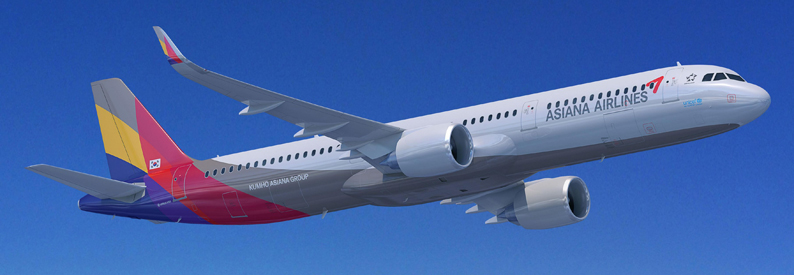
Subsidiary Asiana Airlines is also an A321neo-operator and has eleven of them in the fleet. The airline also holds orders on fourteen more.
Armenian Airlines (Yerevan) took delivery of its first aircraft, an A321-200, on December 7, 2022, although it has yet to secure its Air Operator's Certificate.
OE-ISO (msn 5382), a 10-year-old aircraft formerly operated by Asiana Airlines and owned by Air Lease Corporation, was ferried from maintenance at Ljubljana to Tbilisi. Despite sporting Armenian Airlines' livery, it remains registered in Austria and flew using a generic callsign as Armenian Airlines has yet to obtain its own code.
Armenian Airlines plans to take three A321s and operate a network of scheduled flights, targeting Russia as its main market. Its initial plan was to launch in October 2022.
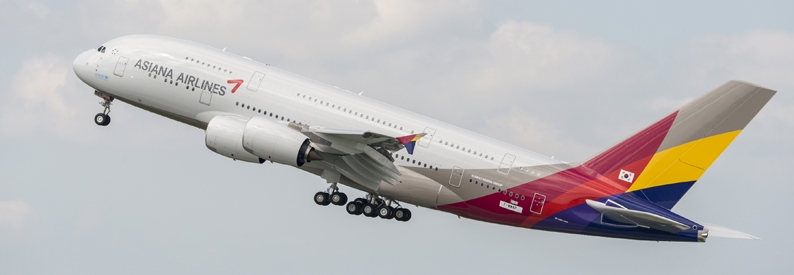
As travel demand slowly picks up, Asiana Airlines (OZ, Seoul Incheon) will join the ranks of airlines reactivating their A380-800s when it deploys the type on two routes out of Seoul Incheon starting on March 27, 2022.
The ch-aviation schedules module indicates the South Korean carrier plans to use the A380 to operate one of its two daily rotations to Los Angeles Int'l (the other one will continue to be served with A350-900s) and its daily rotation to Frankfurt Int'l (currently also served with an A350-900).
Asiana Airlines operates six A380-800s, which have remained grounded since the beginning of the COVID-19 pandemic.Four are owned while the other two are leased from Minsheng Financial Leasing, the ch-aviation fleets ownership module indicates. The aircraft are 6.8 years old on average.
Airbus has logged eleven new orders, 32 deliveries and 92 cancellations in February and has moved into a net negative amount of orders for this year.
Last month, a single A330-200 was ordered by Airbus Defense & Space for conversion to a MRTT and an undisclosed customer ordered ten A320neos.
The manufacturer delivered:
1 A220-300 to Air Canada
1 A320neo to Air China (leased via BOC)
1 A350-900 to Air China
1 A320neo to Air Cote d'Ivoire
2 A321neos to All Nippon Airways
1 A321neo to Asiana Airlines
3 A320neos to China Eastern Airlines
1 A320neo to China Southern Airlines
1 A220-100 to Delta Air Lines
2 A321s to Delta Air Lines
1 A321neo to Gulf Air
3 A321neo to Indigo
1 A320neo to Jazeera Airways (leased via ICBC)
3 A321neos to Jetblue Airways
2 A320neos to Pegasus Airlines
1 A320neo to Shenzhen Airlines
1 A320neo to Sichuan Airlines (leased via CALC)
1 A320neo to SKY Airline (leased via ALAFCO)
2 A321neos to Spring Airlines
1 A320neo to Vietnam Airlines (leased via ICBC)
1 A320neo to Vistara Airlines (leased via Avolon)
1 A320neo to Volaris
The following was cancelled in February:
1 A220-300 by MacQuarie Finance
58 A320neos by Norwegian
30 A321neos by Norwegian
1 ACJ320neo by a Private customer
2 A350-900s by an Undisclosed customer
Another interesting thing in Airbus' February Orders & Deliveries was that the manufacturer unveiled that four Undisclosed orders for the A330-800 are destined for Garuda Indonesia. The Indonesian airline has now ordered for a total of sixteen A330neos; the four -800s and twelve -900s. So far, three A330-900s have been delivered.
Airbus now has logged this year a total of eleven orders and 92 cancellations, meaning it has a net total of -81 orders for 2021.
Asiana Airlines Doubles Its Fleet Of Makeshift Cargo Airbus A350s
South Korea’s Asiana Airlines announced today that it had converted two of its 13 Airbus A350-900s into cargo planes as it looks to expand its air freight business. By doing this, each of the aircraft will now carry an extra five tons of cargo.
The conversion was done to help transport the COVID-19 vaccine. Photo: Vincenzo Pace | Simple Flying
According to Asiana, sales from its freight division reached a record-breaking 2.14 trillion won ($1.9 billion), up 64% from the previous year’s figures. The cargo conversions were also done in preparation for the worldwide distribution of the COVID-19 vaccine.
Asiana added more cargo flights
As well as the two passenger planes that were converted to carry cargo last year, Asiana also used non-cargo planes to transport essential PPE and South Korean exports, adding 849 flights to its cargo operations. When speaking to The Korean Herald, a spokesperson for Asiana Airlines said:
“To convert passenger planes to cargo planes has significantly strengthened our capacity, as demand for air cargo is expected to rise in the age of COVID-19, we plan to focus on cargo flights in many aspects to turn around our performance.”
Asiana was the first airline to convert an A350 into a cargo plane. Photo: Airbus
Last year, Asiana Airlines became the first airline to convert an Airbus A350-900 passenger plane into a main deck freighter. The work involved removing 283 economy class seats and installing a steel panel on the floor. The A350-900 can now carry an additional five tons of cargo, bringing up its total cargo load to 23 tons.
The A350 was put on the ICN-SGN route
The newly modified jet made its first flight as a dedicated freighter on September 23, 2020. It carried 20 tons of IT equipment and electrical parts from Incheon International Airport (ICN) to Los Angeles International Airport (LAX). Following the flight to Los Angeles, the aircraft was put on the high-demand route from ICN to Tan Son Nhat International Airport (SGN) in Ho Chi Minh City, Vietnam.
To help with the conversion, Asiana Airlines worked closely with Airbus and the European Union Aviation Safety Agency (EASA). Since the onset of the COVID-19 pandemic in early 2020, the EASA issued exemption guidelines to airlines so that they could carry urgent medical and PPE supplies. Airbus then worked with the safety agency to develop an SB (Service Bulletin) so that airlines could use the cabins of passenger planes to carry cargo.
When speaking about the decision to convert the A350s, Kim Kwang-Seok, Senior Executive Vice President of Cargo Business at Asiana, said the following,
“We took the decision for aircraft modification after a close review of its capability to secure safety and increase profitability. Cargo sales have become a big part of the airline’s business during the COVID-19 situation, and we will carry out various efforts for the segment.”
When speaking about Asiana’s decision to covert an A350 Anand Stanley, Airbus’ Head of Region, Asia-Pacific, said:
“We congratulate Asiana Airlines on becoming the first operator to convert an A350 using Airbus’ solution. During these challenging times, we are heartened to see our airline partners move nimbly to address their needs. Airbus remains committed to support our airline partners by providing solutions to their new needs.”
South Korea is a major exporter
South Korea is the world’s fifth-largest exporter, so it is no surprise to see Korean carriers turning to cargo when passenger numbers are way down. While air freight will certainly play a vital role in transporting COVID-19 vaccines worldwide, we’re unlikely to see many more airlines converting passenger planes to freighters. Carriers seem to be now pinning their hopes on a summer recovery and will be looking to entice back passengers who have been unable to travel due to coronavirus restrictions.
According to the airline, the CFM International LEAP-1A-powered narrowbody features 188 seats of which 180 are in economy and 8 are in premium. It will be pressed into commercial service on August 8 on flights from Seoul Incheon to Taipei Taoyuan, Clark, and Nagoya Chubu.
The remaining 24 jets will deliver through 2025.
According to the ch-aviation fleets advanced module, Asiana currently operates eighteen A321-100/-200s (two -100s and sixteen -200s) all of which will be gradually replaced by the -neo variant.
South Korea’s Asiana Airlines has signed a Letter of Intent (LOI) with Airbus for the purchase of 25 A321neo single aisle aircraft as part of its ongoing fleet modernisation programme. Seating 180 passengers in a two class layout, the new aircraft will be operated on the carrier’s regional services, as well as on selected domestic routes. Asiana will make a decision on its engine of choice for the aircraft at a later date.
The A321neo will join an existing fleet of A320 Family aircraft operated by Asiana Airlines and its low cost subsidiary Air Busan, with the A321 set to become the primary single aisle type at both units.
"The A320 Family is a proven success with Asiana Airlines and Air Busan, combining reliability, excellent operating economics and superior passenger comfort,” said Kim Soo Cheon, President & CEO, Asiana Airlines. “With the A321neo we will be able to look forward to even greater levels of efficiency, with a 20 per cent reduction in fuel consumption and increased flying range. The acquisition of the A321neo underscores our strategy to operate only the most modern and efficient aircraft that the industry has to offer.”
"We are pleased to announce this latest commitment from Asiana Airlines,” said John Leahy, Airbus Chief Operating Officer, Customers. "The A321neo will bring the airline the lowest operating costs of any single aircraft, flying passengers in comfort on flights of up to six hours. We will be proud to see the A321neo flying in Asiana colours, as part of a fleet that includes aircraft from the entire Airbus product line.”
Asiana Airlines currently operates 33 Airbus singe aisle aircraft, 15 widebody A330-300s and two double deck A380s. In addition to its newly announced commitment for the A321neo, the airline has outstanding orders for four more A380s and 30 all-new A350 XWBs for operation on its long haul network. Meanwhile, Air Busan currently operates nine A320 Family aircraft on its domestic and regional services.
The A321 is the largest member of the best-selling single aisle A320 Family. To date, the A320 Family has won more than 11,500 orders and more than 6,400 aircraft have been delivered to 400 customers and operators worldwide.
 Korean Air welcomes 1st Airbus A350-900s