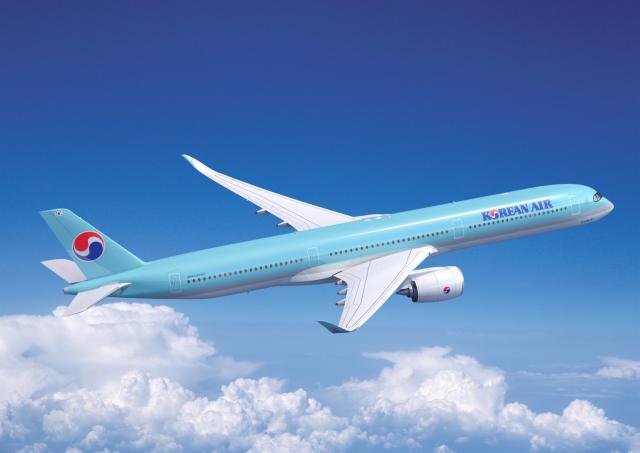
On 31 October 2025, Airbus announced that Korean Air has become the newest customer for its new A350F. The airline has decided to convert seven A350-1000s it had on order into an order for the freighter-variant. As a result of the conversion, the open A350-orders for Korean Air now consists of the seven A350Fs, six A350-900s and 20 A350-1000s.
No delivery timeline has been communicated by either company, although Airbus is aiming for entry into commercial service of the A350F in 2027.
Korean Air will use its new freighters to replace older aircraft in the fleet. The airline's cargo-fleet is currently made-up of four Boeing B747-400Fs, seven B747-8Fs, and twelve B777Fs.
Airbus has now received orders for 78 A350Fs, which breaks down into:
Korean Air (KE, Seoul Incheon) has signed a dry-lease agreement with CALC for one A330-200, returning to the type's operations less than half a year after it was retired. The widebody was delivered to Korean Air in March 2025, added to cover for the delayed deliveries of new aircraft.
Although the airline did not announce which aircraft would join its fleet, but ch-aviation research revealed that B-6135 (msn 1096) flew from Guangzhou and Busan on March 12. It has not been active since. The 15.1 year-old jet is powered by Pratt & Whitney PW4000 engines and is outfitted with 242 economy class seats and 18 in business class. It was last operated by China Southern Airlines, but the ferry flight to Korea was not under that airline's code. It will likely become HL8707 once registered in Korea.
The Korean-language news site The Guru reported, citing an unnamed Korean Air official, that the carrier had decided to dry-lease the aircraft amid delivery delays of factory-new jets. "Nothing has been specifically decided on routes or the timing of the deployment," he added.
ch-aviation asked Korean Air for comment on the new lease deal.
The carrier previously operated eight A330-200s but retired the last of the type in October 2024. It still operates twenty A330-300s, according to ch-aviation fleets data.
Korean Air's chief executive, Won-Tae Cho, said that the airline was "short by about 20 aircraft per manufacturer" which is why it is forced to prolong the service of its A380-800s and B747-8s. Korean is set to receive forty-one A321-200NX, four A350-900s, twenty-seven A350-1000s, nineteen B737-8s, nine B787-10s, and six B787-9s.
On 27 and 30 December 2024, Korean Air took delivery of its first Airbus A350s. Both aircraft are A350-900s and registered HL8597 (681) and HL8598 (689). They were ferried from Toulouse-Blagnac to Busan.
The duo has been delivered all white and it's expected that these will be the first aircraft to receive the airline's new corporate identity which it plans to launch after completing its acquisition of Asiana Airlines.
In March of this year, Korean Air announced it has ordered six A350-900s, and 27 A350-1000s. Freshly bough Asiana Airlines had open orders for fifteen A350-900s.
In a filing to the South Korean Stock Exchange, Korean Air has disclosed it has decided to firm-up options on six Airbus A321neos into firm orders.
Last year, in October 2023, the airline also ordered additional A321neos and has now in total ordered 56 of them. Of these, it has taken, so far, delivery of fifteen of them.
Subsidiary Asiana Airlines is also an A321neo-operator and has eleven of them in the fleet. The airline also holds orders on fourteen more.
More happy Airbus A350-news on 21 March 2024 as Korean Air announced it has selected the aircraft as a replacement for older widebodies in the fleet. In total, the airline is set to order six A350-900s and 27 A350-1000s. No delivery timeline has been communicated by the airline or manufacturer.
The A350 will be a new addition to the fleet, although Korean Air is currently in the process of merging with Asiana, which already operates fifteen A350-900s and has fifteen more on order.
Korean Air's-fleet currently consists of ten A220-300s, nine A321neos, five A330-200s, 20 A330-300s, ten A380s, one B737-700BBJ, two B737-800s, nine B737-900s, six B737-900ERs, five B737-8s, four B747-400Fs, nine B747-8s, seven B747-8Fs, eight B777-200ERs, four B777-300s, 25 B777-300ERs, twelve B777Fs, one B787-8BBJ, and thirteen B787-9s.
Next to its new A350-order, the airline has open orders with Airbus for 41 A321neos and with Boeing for 23 B737-8s, seven B787-9s, and ten B787-10s.
On 30 October 2023, Korean Air announced it has decided to order additional Airbus A321neos. In total, the airline is set to order 20 more aircraft. It hasn't been announced which version of the A321neo has been ordered but we do know that deliveries will run until end December 2030.
So far, Korean Air has taken delivery of eight A321-200NX out of an order of 30 A321neos. With this latest order, the total number of A321neos ordered by the company stands at 50. It started commercial flights with the type in December 2022 and is deploying it on flights from South Korea to destinations in China, Japan and South East Asia like Thailand and Vietnam.
Next to its A321neos, Korean Air has a fleet of ten A220-300s, seven A330-200s, 20 A330-300s, one Boeing B737-700BBJ, two B737-800s, nine B737-900s, six B737-900ERs, five B737-8s, four B747-400Fs, seven B747-8Fs, nine B747-8s, eight B777-200ERs, four B777-300s, 25 B777-300ERs, twelve B777Fs, one B787-8BBJ, and eleven B787-9s.
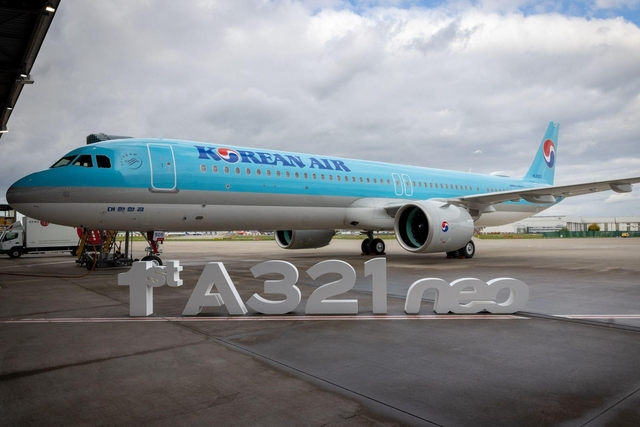
On 30 November 2022, Korean Air officially celebrated the entry into commercial of its newest aircraft type, the Airbus A321neo. The aircraft in question, A321-200NX HL8505 (10977) had already arrived in South Korea on 27 October 2022 when it was delivered from Hamburg-Finkenwerder to Seoul-Gimpo with a stop at Tashkent. Since then the Airbus has been used for crew-training flights, mainly between Seoul-Gimpo and Seoul-Incheon and Seoul-Gimpo to Jeju.
Korean Air has a total of 30 A321neos on order, with options on another twenty. It plans to deploy the aircraft on domestic and intra-Asian flights. Earlier this year, the airline also took delivery of its first of 30 Boeing B737-8s.
In total, Korean Air is now operating a fleet of 157 aircraft, consisting of ten Airbus A220-300s, one A321-200NX, eight A330-200s, 21 A330-300s, ten A380-800s, one Boeing B737-700BBJ, two B737-800s, ten B737-900s, six B737-900ERs, five B737-8s, one B747-400, four B747-400Fs, nine B747-8s, seven B747-8Fs, ten B777-200ERs, four B777-300s, 25 B777-300ERs, twelve B777Fs, one B787-8BBJ, and ten B787-9s.
Narrative: Korean Air flight 631, an Airbus A330-322, suffered a runway excursion after landing on runway 22 at Mactan-Cebu International Airport (CEB), Philippines. The aircraft struck the ILS localizer antenna array for runway 22, after overrunning the end of the runway. The nose landing gear appears to have collapsed prior to the aircraft hitting the antenna array.
The flight departed Seoul-Incheon International Airport (ICN) at 10:20 UTC on a flight to CEB. At 14:12 UTC the flight aborted the first approach to runway 22 at CEB, likely due to inclement weather as there was a thunderstorm in the area with Cumulonimbus clouds at 1800 feet. The flight crew positioned for a second approach, which was aborted at 14:26, shortly after crossing the runway threshold. The aircraft then entered a holding pattern for about 30 minutes, before a third approach was attempted. At 15:08 UTC (23:08 local time) the aircraft touched down on runway 22 and overran the end of the runway. Runway 22 has a Landing Distance Available (LDA) of 3310 meters.
Asiana And Korean Air To Retire Their Airbus A380s Within Five Years
The A380 has suffered another blow this week as Korean Air has confirmed that it will be retiring its superjumbos within the next five years, ending the type’s tenure of a decade and a half. However, the upcoming merger with Asiana means that it too will lose all six of its A380s, which have served less than a decade currently. Let’s find out more about the loss of two superjumbo operators.
Out
According to Executive Traveller, Asiana will follow Korean Air’s decision to ax the Airbus A380 from its fleet within five years. The private South Korean airline flies six superjumbos currently, which are some of the youngest in the skies. Having only taken its first delivery in 2014, Asiana’s A380s only average an age of 6.6 years.
However, these aircraft are unlikely to survive much longer than a decade. As the merger of Korean Air and Asiana begins to take shape, the decision to remove the A380 seems to have been set in stone. With the deal set to close in 2024, there is a small chance that the carrier will operate 16 A380s, but this will be at most for two years.
While disappointing to many, Asiana’s move hardly comes as a surprise. Considering Korean Air is buying the airline, it would make little sense to operate a smaller fleet of six planes while 10 are retired. Instead, Korean will focus on using twin-engine widebodies for most of its missions, while relying on the 747-8 for high-density ones. The 747s are here to stay for nearly another decade.
Two down
While Korean and Asiana aren’t saying goodbye to their A380s during the pandemic, it is certainly due to it. As the global aviation recovery still struggles to find its feet, there is little use for the 400+ seater jets currently. While the planes will likely make a comeback by next year or so, their efficiency remains largely in doubt compared to newer aircraft.
The decision will leave two fewer superjumbo operators going into the next half of the decade. While Emirates and Singapore Airlines will retain their top two positions, they will only be joined by four others for certain. For several other carriers, like Qatar Airways, the A380 plans remain a mystery.
Not the end
While the announcement of the A380s departure isn’t good, its continued presence is! The fact that Korean and Asiana will both maintain their A380s for the next five years is a shot in the arms for fans and another chance to fly the bird. Once these planes return to the skies, expect to see more travelers as the era of the double-decker jets begins to come to a close.
In an interview with Flight Global, the CEO of Korean Air has said the airline plans to retire its A380s within five years and its B747-8s to follow soon, within ten years. The CEO didn't mention if this would also be the case for Asiana's A380s which it will obtain after the merger but we can expect so.
Korean Air currently has a fleet of ten A380s (of which only one is in operation) and ten B747-8s (of which also only one is flying). Asiana itself has six A380s which are all stored.
In the interview the CEO said he isn't planning to replace the capacity with new aircraft like the B777-9, although he doesn't rule it out completely. However, with open orders for ten B787-9s and twenty B787-10s and the upcoming merger with Asiana, Korean Air thinks it has sufficient capacity. Next to the open widebody orders, Korean Air also has open orders for 30 A321neos and 30 B737-8s.
Today, Korean Air's fleet consists of ten A220-300s, eight A330-200s, 22 A330-300s, ten A380s, one B737-700BBJ, three B737-800s, twelve B737-900s, six B737-900ERs, four B747-400Fs, ten B747-8s, six B747-8Fs, twelve B777-200s, four B777-300s, 26 B777-300ERs, twelve B777Fs and ten B787-9s.
Asiana on its turn has a fleet of two A320s, fifteen A321s, four A321neos, fifteen A330-300s, thirteen A350-900s, six A380s, twelve B747-400Fs, five B767-300s, one B767-300F and nine B777-200s.
Korean Air opts for PW1100G to power its future Airbus A321neo fleet
Seoul, South Korea - Korean Air has opted for Pratt & Whitney's PW1100G engines to power its future Airbus A321neo fleet that will consist of 50 aircraft.
The SkyTeam member carrier will begin to take delivery of its PW1100G engines from next year.
Korean Air is a loyal P&W Pratt & Whitney customer. Its engines also equip several other aircraft in the Asian carrier’s fleet, including 18 Boeing 777s, six 747s, and 29 A330s.
Joining the GTF MRO network is a significant milestone that will allow Korean Air to enhance its MRO capability,
Korean Air chief operating officer Soo-Keun Lee said.
Narrative: Korean Air flight KE753, an Airbus A220-300, returned to land at Busan, South Korea after suffering an engine failure. The aircraft departed Busan Airport at 13:01 hours local time (04:01 UTC) on a regular flight to Nagoya, Japan. The flight crew stopped the climb at about FL290 while some 193 km from Busan over the Sea of Japan after the aircraft suffered a failure of the no.1 engine (PW1524G). The aircraft returned and landed safely back at Busan at 14:00 hours.
Photos from the incident aircraft show damage to all blades of the last Low Pressure Turbine (LPT) stage of the engine.
Korean Air has signed a Memorandum of Understanding (MOU) with Airbus to acquire up to 50 A321neo aircraft, becoming a new customer for the best-selling single aisle A320 Family. The agreement, covering 30 aircraft plus 20 options, was announced today at the Paris Air Show by Korean Air Group Chairman Cho Yang Ho and Airbus President and CEO Fabrice Brégier. Korean Air will operate the A321neo with a two class full service layout on regional services, including on longer sectors to selected destinations in South East Asia. The aircraft will be fitted with premium amenities, including wider seats in both classes and the latest in-flight entertainment and connectivity systems.
“After an extensive technical evaluation we are pleased to announce that Korean Air will introduce Airbus single aisle aircraft for the first time,” said Cho Yang Ho, Chairman of Korean Air Group. “The A321neo will bring new levels of efficiency, longer flying range and greater in-flight comfort to our single aisle fleet, as well as reduced impact on the environment. Today’s decision is part of our ongoing commitment at Korean Air to offer true excellence in flight wherever we fly.”
“This agreement marks another milestone in the long-standing relationship between Korean Air and Airbus,” said Fabrice Brégier, Airbus President & CEO. “It’s also a very significant endorsement of the advantages offered by the A321neo at the top end of the single aisle market. We look forward to seeing the A321neo take to the skies in the colours of Korean Air, flying alongside the airline’s existing Airbus widebody fleet.”
Korean Air is Airbus’ longest-standing customer from outside Europe and placed its first order with the manufacturer in 1974. Since that time Airbus widebody aircraft have formed a major part of the Korean Air fleet. Today, the double deck A380 is the flagship of the airline’s long haul fleet, while mid-size A330 is operated by the airline on services across the Asia-Pacific region, as well as on selected routes to Europe.
The A321 is the largest member of the best-selling single aisle A320 Family. To date, the A320 Family has won more than 11,700 orders and over 6,500 aircraft delivered to more than 300 operators worldwide. Incorporating new engines and the latest technologies, the A320neo Family will bring a step-change reduction in fuel consumption of over 15 per cent, longer range capability and reduced maintenance costs, as well significantly reduced carbon emissions.
Since its launch in 2010 the A320neo Family has won almost 60 per cent of all new orders for single aisle aircraft with over 100 seats and has been selected by over 70 airlines worldwide.
Korean Air Lines said on Tuesday that it plans to invest KRW1.8 trillion won (USD$1.6 billion) in 2012 and purchase 14 aircraft including Airbus's flagship A380 superjumbo.
The carrier also said in a statement that it targeted KRW12.8 trillion won in sales this year and an KRW820 billion won operating profit.
 Korean Air places Airbus A350F-order