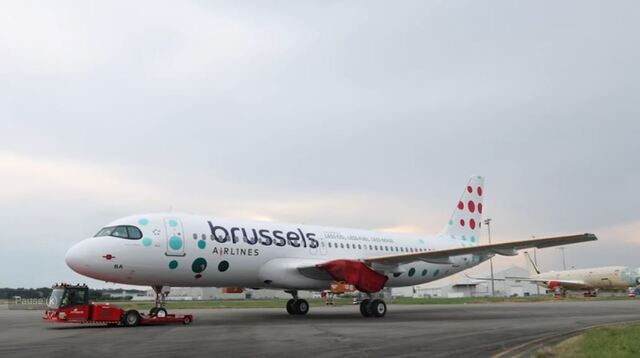
On 26 March 2025, Brussels Airlines unveiled a new Belgian-icon aircraft to its fleet. This time, the airline has given Airbus A320 OO-SNM (2003) a special livery, honoring the Atomium in Brussels. It flew commercially for the first time from Brussels to Prague on 27 March 2025.
The idea of the Belgian icons is to "introduce the best of Belgium to the world. The Belgian icons are known all over the world and make flying even more fun".
Currently, there are four Airbus A320s wearing a special Belgian-icon livery:
A320-251N OO-SBB (11790), wearing a Tomorrowland-livery since April 2024
A320-214 OO-SNB (1493), wearing a Tintin-livery since March 2015
A320-214 OO-SNM (2003), wearing a Atomium-livery since March 2025
A320-214 OO-SNO (3831), wearing a Red Devils-livery since November 2022
In the past there were four more Belgian icon-liveries, which were applied on:
A320-214 OO-SNA (1441), which wore a Red Devils-livery between April 2016 and August 2022
A320-214 OO-SNC (1797), which wore a Margritte-livery between March 2016-April 2021
A320-214 OO-SND (1838), which wore a Smurfs-livery between March 2018-January 2024
A320-214 OO-SNE (4243), which wore a Pieter Bruegel-livery between May 2019 and January 2024
Of these four, only OO-SNE is currently still flying with the airline, the other three have left the fleet.
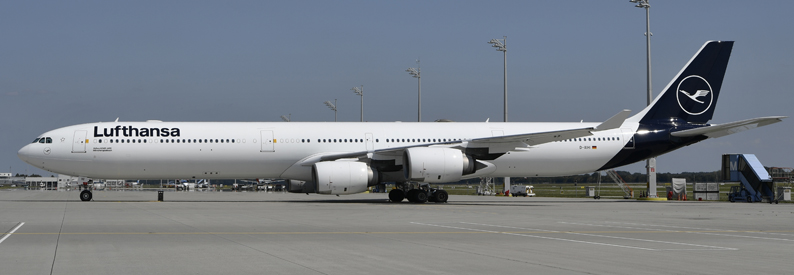
The ch-aviation fleets module shows the airline currently operates seventeen A340-300s, seventeen A340-600s, and eight B747-400s. It owns all of these aircraft. It also operates nine A330-300s, and while it no longer operates any A330-200s, having retired all five as of 2006, its leisure-focused Discover Airlines (4Y, Frankfurt International) subsidiary operates three.
Lufthansa did not respond to ch-aviation's request for confirmation that the announced plan pertains to the Discover-operated A330-200s.
Lufthansa's quadjet fleet also comprises eight A380-800s (of which five are currently active) and nineteen B747-8s.
Lufthansa Group conceded in its quarterly earnings release that it was becoming "increasingly challenging" for its mainline to hope to break even in 2024. The holding posted a EUR212 million euro (USD229 million) operating loss for the first half of 2024, while Lufthansa itself recorded a EUR442 million (USD478 million) operating loss.
The holding blamed late aircraft deliveries as one of the causes of its current headaches. On a group level, it took 41 fewer B787-9s and B777-9s between 2019 and now than it had planned. It compensated for the delays by extending the service lives of twenty-three A340-300s and B747-400s. This only partially offset the delays, with 18 aircraft still missing, while at the same time there were rising fuel and operating costs. The changes also increase "irregularity costs" and lower crew productivity. As a result, Lufthansa Group estimates the cost of delayed widebody deliveries to be in triple-digit millions of euros.
Lufthansa has twenty-one B777-9s, seven B777-8Fs, and thirty-four B787-9s remaining on orders from Boeing.
The holding identified a host of other issues affecting its mainline carrier, such as "negative market development in the key Asia-Pacific traffic region, inefficiencies in its Lufthansa and Lufthansa CityLine flight operations", and "the disproportionately high increase in location cost in Germany and new collective labour agreements".
The newly launched turnaround programme, which aims to make Lufthansa "fit for the future" and "the Group's flagship again", will also tighten the focus on its premium product, more seasonal network, an increase in Lufthansa City Airlines and Discover operations, and other improvements. Lufthansa Group noted that its other carriers "remain on course in line with market developments". Nonetheless, Swiss was the only one to post an operating profit in the first half of the year. Austrian Airlines, Brussels Airlines, and Eurowings all posted small operating losses not exceeding EUR100 million (USD108 million).
Brussels Airlines takes delivery of first Airbus A320neo
A happy moment for Brussels Airlines on 1 November 2023. The airline took delivery of its first Airbus A320neo, arriving from Toulouse-Blagnac at Brussels. The aircraft, OO-SBA (11600), was welcomed with the traditional water salute and will now be prepared for entry into commercial service.
The A320neo is the first of five the airline will take delivery of between this year and end 2024. It joins a fleet of sixteen A319s, eighteen A320s, and nine A330-300s.
The first Airbus A320neo for Brussels Airlines has rolled out of the paintshop at Toulouse-Blagnac, on 1 June 2023. The aircraft, currently wearing test-registration F-WWIJ (11600), will become OO-SBA and is expected to be delivered in August. Commercial flights are scheduled to begin in October.
In total, Brussels Airlines will take delivery of four A320neos, two this year, and two next year. The airline will use them to replace older A319s in the fleet and they are coming from the existing orderbook the Lufthansa Group has with Airbus. Brussels Airlines announced it would receive A320neos in June 2021.
Today, the airline is operating a fleet of 43 aircraft consisting of sixteen A319s, eighteen A320s, and nine A330-300s.
Brussels Airlines has today announced that it will take delivery of three Airbus A320neo aircraft in 2023. The news comes following a meeting between the Lufthansa Group Executive Board and the Board of Directors of SN Airholding. The airline says that the three new state-of-the-art aircraft will allow it to modernize its fleet further.
This will be the first time Brussels Airlines has received a brand new plane. Photo: Brussels Airlines
Furthermore, the addition of the new aircraft will significantly lower the airline’s medium-haul CO2 emissions and help lower noise levels over incoming and outgoing flight paths. Brussels Airlines was also keen to point out that it will be the first time in the airlines’ 19-year history that it will be receiving new aircraft directly from the factory.
Brussels Airlines wants to replace its A319s
When speaking about the new planes in the statement, CEO of Brussels Airlines Peter Gerber said:
“As a responsible airline with ambitious sustainability targets, it’s crucial for us to continue our path of further modernizing our fleet. Thanks to our mother company Lufthansa, we are, for the very first time in our 19 year-long history, able to replace the older A319 Airbus with three modern and fuel-efficient aircraft that will leave the Airbus factory by summer 2023.
“Compared to our A319 aircraft, the three A320neo will allow a noise contour reduction of 50% and reduce fuel use and CO2 emissions by 11% per flight. Furthermore, thanks to the higher seating capacity of this ultra-modern Airbus, the fuel use and CO2 emissions per seat will decrease by 30%.”
Brussels Airlines wants to phase out its A319s. Photo: Brussels Airlines
Brussels Airlines chief operating officer (COO) Edi Wolfensberger then weighed in with his thoughts on how the new aircraft will help the Lufthansa Group airline not only lower CO2 emissions but harmonize its medium-haul fleet, saying:
“Needless to say, that we are extremely enthusiastic to welcome the Airbus A320neo in our fleet. The modern General Electric CFM engines of the Airbus A320neo are renowned for their fuel efficiency and lower noise contour.
“Next to that, the three new aircraft will bring us closer to our target of a fully harmonized A320 medium-haul fleet to aircraft only, herewith further reducing the complexity of our Maintenance & Engineering activities and the whole operation. Due to the high similarity with the current fleet, the crews are able to operate the new aircraft after a short familiarisation; this makes the integration seamless.”
Brussels Airlines is committed to reducing CO2
By investing in new planes when the aviation industry has seen its worst-ever year thanks to the COVID-19 pandemic, Brussels Airlines shows how committed the Lufthansa Group is to lowering CO2 emissions. The Groups sustainability target is to reduce its 2019 CO2 emissions by 50% by 2030 and become CO2 neutral by 2050.
Compared to the older Airbus A319 aircraft that are to be phased out, the Airbus A320neo burns 11% less full and cuts noise levels by 50%. Also, because the A320neo has a larger capacity (27%), the fuel use per seat is reduced by 30% compared to an A320 without the new engine option. The neo option uses 16% less fuel than the old option and reduces CO2 emissions by 16% while carrying the same number of passengers.
According to the aviation data and statistics website, ch-aviation, Brussels Airlines has a fleet of 46 aircraft comprising the following planes:
As you can see from the above figures, Brussels Airlines relies heavily on the Airbus A319. The average age of its A319 fleet is over 16-years-old. This means that to harmonize its medium-haul fleet, other A319s will have to be swapped out for other Lufthansa Group A320s.
Brussels Airlines Set To Repaint Its Tintin Airbus A320
Brussels Airlines will repaint its iconic Tintin Airbus A320 Rackham after the plane reached its repainting deadline this year. The aircraft’s outer paint job will remain identical, while the interior will be decorated with brand-new Tintin illustrations this time around.
Brussels Airlines will replenish the outer layer and add new Tintin illustrations to the interior. Photo: Airbus
Rackham will get a fresh repaint
Back in 2015, Brussels Airlines introduced the first of several aircraft painted with unique liveries. The plane, an Airbus A320 (registration: OO-SNB), was painted with a special Tintin livery and given the name ‘Rackham.’ Now, six years after Rackham was first painted, Brussels Airlines will replenish its outer coat and also add additional Tintin illustrations throughout the interior.
The airline will undertake the restoration project in partnership with Moulinsart studio. The company owns the rights to the works of Tintin creator Hergé, the pen name of writer Georges Remi. Moulinsart took part in the original painting project and will team up with Brussels Airlines’ maintenance division once again. The repainting and interior redesign project is expected to be complete in June 2021.
The aircraft itself is 20 years old and began life under German leisure airline LTU. Before Brussels Airlines acquired the plane (in 2011 on lease from AerCap), it was decorated with two different special liveries in the 2000s. In 2002, the plane was painted in the colors of German football club Hertha BSC, while in 2005 it was repainted in the colors of another football club, this time for the Spanish team RCD Mallorca.
One of the world’s most photographed planes
Rackham’s striking paint job has attracted hordes of aviation enthusiasts and Instagrammers ever since it first took to the skies. Within six months of receiving its new livery, the plane was mentioned by almost six million accounts on Twitter, while its official page on the Brussels Airlines website attracted over 100,000 views.
The plane’s paint scheme is derived from the 12th volume of The Adventures of Tintin, ‘Red Rackham’s Treasure.’ In the story, Tintin and his canine companion Snowy search for hidden pirate treasure in a shark-themed submarine. This inspired the final design on Rackham, which depicts Tintin and Snowy submerged in the ocean and a shark head at the aircraft’s nose.
Tintin is one of Belgium’s most famous cultural exports. The comic strip was first published in 1929 and has since become one of the top-ten best-selling comics of all time. Interestingly, passengers onboard Rackham can read the volume that inspired its paint job, Red Rackham’s Treasure, in Dutch, French or English.
Brussels Airlines’ other unique aircraft
After Rackham went down as a hit, Brussels Airlines started working on other unique liveries for its fleet. In 2016, the carrier introduced two more planes with special colors – Magritte and Trident. The first aircraft commemorates Belgian surrealist artist René Magritte, while Trident was created to support the Belgian national football team and has flown the team to its away games.
The airline plans to continue its ‘Belgian Icon’ series for its future fleet. Photo: Airbus
Brussels Airlines followed up with three more unique liveries – Amare, Aerosmurf and Bruegel. Although Rackham will have its livery replenished, Magritte will be repainted in regular Star Alliance colors. Additionally, Trident will receive a partial repaint and an updated interior. The plane is currently set to leave the Brussels Airlines fleet in November 2022.
Brussels Airlines is currently preparing for a busy summer season. Photo: Airbus
With Rackham’s restored livery and new interior set to be completed next month, Brussels Airlines has promised that the plane will be a part of the fleet for at least the next five years. As for its other special planes, Brussels Airlines plans to keep them in the fleet for the next few years and will continue its ‘Belgian Icon’ series in the future.
Brussels Airlines Says Goodbye To Its Last Airbus A330-200
Belgium’s national flag carrier and the country’s largest airline, Brussels Airlines, is sending its last remaining Airbus A330-200 to the Netherlands, where it will be dismantled and sold off for spare parts. At lunchtime today, the aircraft, registration OO-SFZ, will depart Brussels Airport (BRU) for Enschede Airport Twente (ENS).
Brussels Airlines had three Airbus A330-200s
According to Aviation24.be, once on the ground in Holland, the aircraft will be handed over to specialist aircraft dismantling company AELS (Aircraft End-of-Life Solutions), who will carefully take the plane apart. Once in pieces, the parts are labeled, recertified, and returned to the market as spare parts. AELS is the only company that can handle the entire supply chain for aircraft disassembly and dismantling.
Brussels Airlines has 12 Airbus A330-300s
According to Planespotters.net Brussels Airlines had three Airbus A330-200s in its fleet with OO-SFZ the last remaining -200 version following OO-SFY being sent to Enschede Airport Twente in August 2019.
The distance between BRU and ENS is 141 miles. Image: GCmaps
Before today, OO-SFZ was still active in the Brussels Airlines fleet. However, it had remained parked for several months following the coronavirus outbreak in Europe last spring. Brussels Airlines’ remaining long-haul fleet is now exclusively composed of 12 Airbus A330-300s with an average age of 13.8 years.
About the Airbus A330-200
Derived from the Airbus A300, the Airbus A330-200 is a short version of the Airbus A330-300. The A330-200 is a twin-aisle widebody jet with a range of 7,250 nautical miles ( 13,450 kilometers). Brussels Airlines’ Airbus A330-200s had 272 seats laid out in a three-class configuration.
Business class has 22 flatbed seats, while premium economy offers 32 seats that are slightly wider than the 218 seats in economy class. Brussels Airlines used its A330-200 on routes between Belgium and the United States and between Belgium and long-haul routes in Africa.
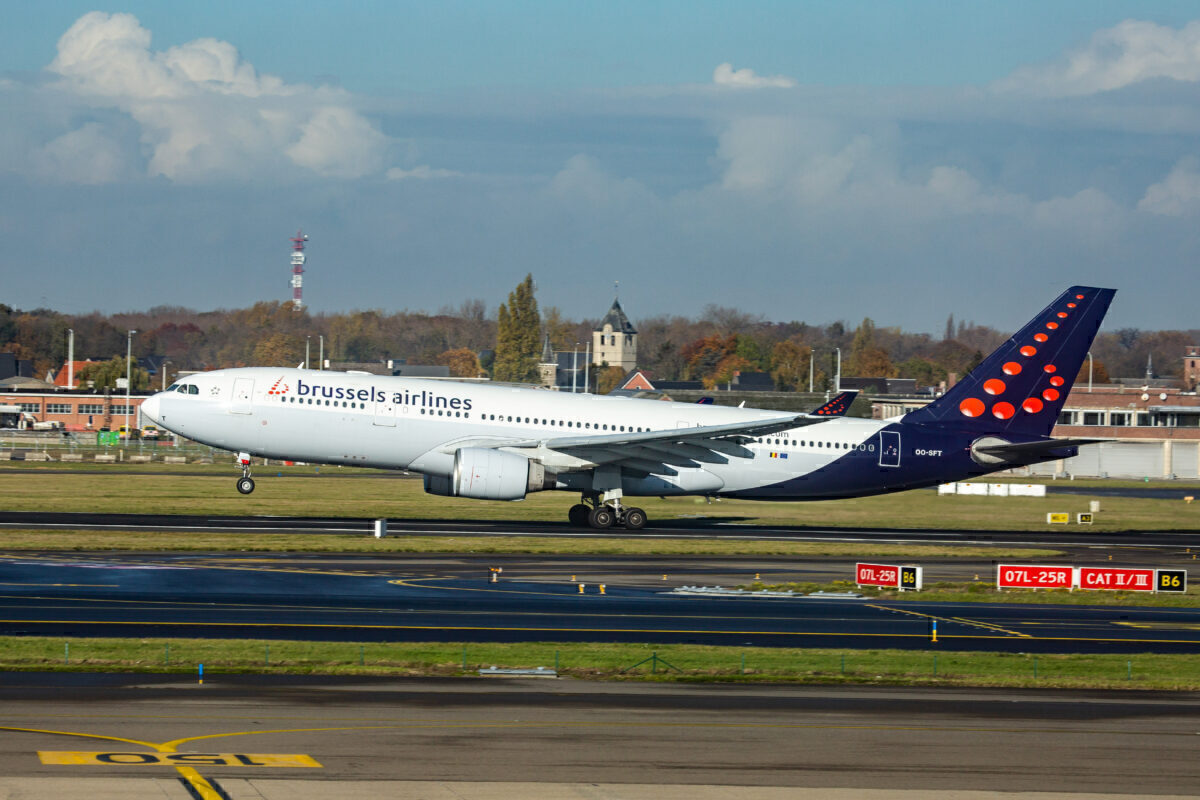
Brussels, Belgium - Brussels Airlines said goodbye to one of its three remaining Airbus A330-200 aircraft. On April 9, the wide-body jet with registration OO-SFU took off from Brussels International Airport and headed Arizona, where it will be dismantled.
It is the second Airbus A330-200 jet, which left the airline's fleet within four months. The first A330 with registration OO-SFW was also ferried to Pinal Air Park, Arizona in November 2019 to be scrapped.
The OO-SFU initially entered into service in May 2000 with the former Belgian flag carrier Sabena. The aircraft flew under the colors of Sabena until the airline went bankrupt in 2001. In 2002, the aircraft was leased by Lufthansa Group. It was first operated by Lufthansa for four years and then by another group subsidiary airline Swiss International Airlines for two and a half years. It then was leased by Australia's Strategic Airlines in 2009 and served there until the end of 2011.
The plane joined the Brussels' fleet in April 2013. It made its final scheduled flight between Douala and Brussels on March 16.
Lufthansa Group has outlined plans to drastically reshape the fleets that its various AOCs operate in the interests of matching capacity to demand in a soon-to-come post-COVID-19 world.
A statement issued after a Tuesday boardroom meeting said that six out of Lufthansa's fourteen A380-800s, seven of its seventeen A340-600s, and five of its thirteen remaining B747-400s are to be permanently decommissioned. In addition, eleven A320-200s will be withdrawn from short-haul operations.
"The six A380s were already scheduled for sale to Airbus in 2022," it said. "The decision to phase out seven A340-600s and five B747-400s was taken based on the environmental as well as economic disadvantages of these aircraft types. With this decision, Lufthansa will be reducing capacity at its hubs in Frankfurt Int'l and Munich."
Furthermore, Lufthansa CityLine (CL, Munich) will also withdraw three of its five A340-300s from service. Since 2015, the regional carrier has been operating flights to long-haul tourist destinations for Lufthansa.
As recently reported, Eurowings (EW, Düsseldorf Int'l) will see its germanwings (4U, Cologne/Bonn) subsidiary shuttered while the number of aircraft it operates overall will be reduced by ten A320-200s. In addition, Eurowings' long-haul flying will be curtailed.
Concerning Austrian Airlines (OS, Vienna) and Brussels Airlines (SN, Brussels National), the group said existing restructuring programs will be further intensified due to the coronavirus crisis. Among other things, both companies are working on reducing their fleets. Swiss (LX, Zurich) will also adjust its fleet size by delaying deliveries of new short-haul aircraft and will also consider early phase-outs of older aircraft.
In its own press release, Austrian Airlines said that it did not anticipate a return to the pre-COVID-19 level of demand before 2023 at the earliest. As such, the Austrian unit of Lufthansa Group was talking with its parent and social partners about "realignment including a reduction in the size of the fleet and consistent restructuring".
In addition, Lufthansa Group airlines have already terminated "almost all" wet-lease agreements with third-party airlines. Though the exact contracts that have been axed were not specified, at present time, the list includes:
"The aim remains the same for all employees affected by the restructuring measures: to offer as many people as possible continued employment within the Lufthansa Group," it added. "Therefore, talks with unions and workers councils are to be arranged quickly to discuss, among other things, new employment models in order to keep as many jobs as possible."
MIAMI — A Brussels Airlines Airbus A330-223, performing flight SN358 from Kinshasa to Brussels, suffered failures on both engines at different stages of its journey.
According to aviation-safety.net, as the aircraft reached its cruising altitude of 40,000ft over Algerian airspace, the number-one engine failed.
The crew immediately declared an emergency and planned to land in Djerba–Zarzis International Airport, in Tunisia.
However, the flight crew managed to re-ignite the failed engine and decided to continue its original route to Brussels.
As noted on the aviation safety site, the aircraft suffered yet another engine failure as it descended towards Belgian airspace. “When in descending towards Brussels, at 05:37 hours, engine no. 2 failed several times.”
The aircraft’s left one was shut down as it traveled through French airspace, descending from 40,000ft to 28,000ft to continue its journey to Belgium.
Later on, at 05:45 hours, the aircraft landed safely on runway 25L at Brussels Airport.
This incident reminisces Air Transat’s Flight 236, another Airbus A330, which ran out of fuel and both engines flamed out. The plane came to a successful emergency landing in the Azores, saving all 306 people on board.
The post-landing investigation revealed that, due to improper maintenance, there was a fuel leak that caused all tanks to be emptied out, causing the dual flameout.
In Brussels Airlines’ case, the cause of both engines’ malfunctions might be related to fuel contamination. An official statement from the airline is still to be heard.
Aircraft History
This particular aircraft was delivered to Sabena in 2000. Following the airline’s demise, it remained in storage in Brussels and Bremen until January 2002, when it was taken over by Airbus Industrie and re-registered F-GHYI.
In November that year, Lufthansa took over the aircraft’s operational permit, changing its registration to D-AIME. Curiously, this registration is today active on one of Lufthansa’s Airbus A380s.
Aero Icarus
The A330 flew for the German airline until 2006, when it was transferred to Swiss, changing its registration number to HB-IQR, once again.
In 2009, the widebody was transferred to Strategic Airlines in Australia, where it remained until February 2012 having flown for Air Australia for a few months. During this time, the plane operated with the registration VH-SSA.
At last, the A330-200 was transferred to Brussels Airlines in 2013, where it returned to its original registration, OO-SFU.