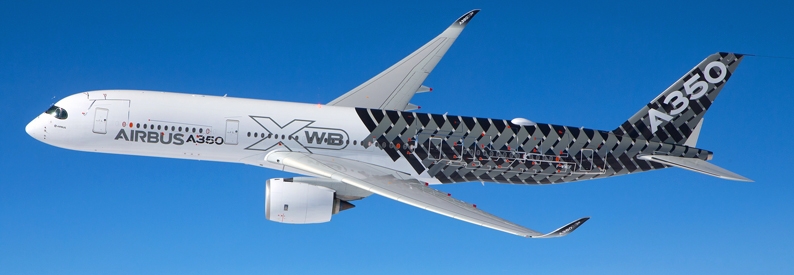
Airbus (AIB, Toulouse Blagnac) is considering delaying its previously announced ramp-up in A350 production from five to six units per month until late 2023 amidst an ongoing dispute with Qatar Airways (QR, Doha Hamad Int'l) coupled with the impact of the Russian invasion of Ukraine, Bloomberg has reported, citing internal sources.
The European manufacturer originally planned to increase its A350 roll out rate in late 2022 but later deferred that to early 2023.
In a statement to Reuters, Airbus said it continued "to expect to increase the A350 production rate from around five per month to around six in early 2023".
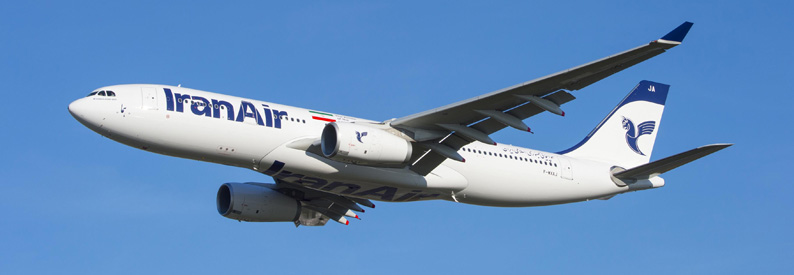
sixteen A350-1000s ordered by IranAir (IR, Tehran Mehrabad), which is also subject to international sanctions, and
twenty-one A350-1000s ordered by Qatar Airways, which refused to take any more units of the type pending the resolution of the legal dispute over fuselage paint deterioration.
Iran Eyes Legal Action Against Airbus And ATR Over Spare Parts Supply
Iran’s aircraft fleet has been suffering from a lack of parts, with an estimated 50% of its passenger planes reportedly grounded due to technical problems. Now, the civil aviation chief of Iran has said that the country intends to pursue legal action against both Airbus and ATR regarding their lack of parts supply. Mohammad Mohammadi Bakhsh said at the weekend that the contracts to supply these parts were signed before the US sanctions were imposed, and therefore should be fulfilled.
Iran is ready to take Airbus and ATR to court over a lack of spare parts supply. Photo: Getty Images
Legal action considered
Iran’s civil aviation chief has stated this week that the country intends to take legal action against Airbus and ATR regarding the lack of supply of parts for its aircraft. Mohammad Mohammadi Bakhsh claims that both planemakers refuse to honor their contractual obligations to deliver the parts, telling PressTV that,
“Airbus and ATR have cited the US sanctions whenever the issue was raised. Hence, we are protesting this decision and will be pursuing legal actions against them.”
Bakhsh notes that the parts supply contract was signed before the US reimposed sanctions on the country, and says that the two manufacturers should stick by their agreements. He further warns that the failure to supply these parts could cause a major incident. He said that Iran would pursue the legal case against the companies regardless of the outcome of talks with world powers regarding Iran’s nuclear deal.
In December last year, it was estimated that more than 170 aircraft were grounded in Iran, representing over half of its passenger fleet. Alireza Barkhordar, vice president of Iranian Airlines Association’s board of directors, told the Financial Tribune that,
“If the status quo persists, we will see more planes grounded in the near future.”
More than half of Iran’s passenger planes are grounded
Iranian airlines are notorious for flying older and less common aircraft, with examples of the A300/A310 and F100 still actively in use in the country. Much of this was a hangover from the sanctions against Iran, which have been in place, on and off, since 1995. Sanctions prevented aircraft manufacturers from supplying new planes or parts, leaving Iranian airlines to manage with their older airframes.
But the sanctions were lifted in 2015, which saw Iranian airlines signing a flurry of orders to renew their aging fleets. By 2016, deals had been signed relating to 100 Airbus jets, 80 Boeing aircraft, and 40 ATR turboprops. But only 11 aircraft were delivered to the airlines before 2018 saw sanctions reapplied as the US withdrew from the nuclear deal. Arriving in the country so far has been one Airbus A321, two Airbus A330s, and eight ATR 72-600s.
While Iranian airlines would love to have their new aircraft delivered, the immediate requirement is for spare parts to reactivate their grounded planes. Operating these older aircraft means a constant need for parts and equipment to keep them flying, but neither ATR nor Airbus have been delivering the parts for fear of breaching the US sanctions.
In time, it is expected that President Biden will rescind the sanctions. However, in the meantime, the only way Iranian airlines can secure parts for their grounded aircraft is by using intermediaries to sneak them into the country. The airline ends up paying a significant markup on the part, which comes with no documentation or historical records, risking the safety of operations.
Iran Air Receives Three Second-Hand airbus a319 Aircraft
LONDON – Local Iranian news agency Mehr News has announced Iran Air has received three Airbus A319 aircraft, irrespective of U.S sanctions imposed on the country and carrier.
The aircraft are secondhand and were manufactured in 2002. It was purchased from Hungary a year ago and landed in Mashhad in North West Iran.
The aircraft are to join the airline’s fleet in the next few days.
At the moment, Iran Air operates 29 flights in the country, which will rise to 32 after the aircraft have been added.
The Civil Aviation Organisation (CAO) for Iran gave the approval to the carrier to purchase and import the planes last week.
The permits are independent of the government, offering a more private way forward for aviation operations in Iran.
According to Ali Abedzadeh, who works in the Tourism ministry believes that up to 500 civil aircraft are needed in Iran, with the CAO trying to facilitate this as much as possible.
The U.S sanctions has forced Iran to go into the second-hand market as it had ordered Airbus and ATR aircraft brand new.
The airline had ordered 100 Airbus aircraft, 80 from Boeing and 20 from ATR originally but the licenses on these aircraft were withdrawn after U.S President Donald Trump pulled out of the Iran Deal and reimposed sanctions in May last year.
ATR have however managed to deliver 13 of the 20 aircraft before the sanctions were imposed but the rest are yet to be delivered.
Airbus has also shown the orders as still active, with Boeing the only manufacturer showing as inactive.
It remains clear that Iran is still committed to growth and will do everything it can to grow, whether that is go through the second-hand market.
The US Department of the Treasury has announced that it will cancel export licences granted to Airbus (AIB, Toulouse Blagnac) and Boeing (BOE, Chicago O'Hare) among others for the sale of aircraft and sundry parts to Iran following the US's decision to withdraw from the P5+1 nuclear accords.
In a televised press conference on May 8, United States president Trump said Iran had failed to live up to the terms of the 2015 Joint Comprehensive Plan of Action, or JCPOA, signed with the United States under the Obama administration, as well as Russia, China, the United Kingdom, France, and Germany.
"I will sign a presidential memorandum to begin reinstating U.S. nuclear sanctions on the Iranian regime," the President said. "We will be instituting the highest level of economic sanction."
In a follow up statement, US Treasury Secretary Steven Mnuchin said the sales of commercial aircraft would have to end within 90 days, or by August 6, 2018.
"Under the original deal, there were waivers for commercial aircraft, parts and services and the existing licenses will be revoked,” Mnuchin noted. “These are very very strong sanctions; they worked last time. That’s why Iran came to the table."
In terms of Iranian carrier orders From the Europeans, Iran Air ordered thirty-two A320neo, eight A321ceo (of which one was delivered), eight A330-200s (of which two were delivered), twenty-eight A330-900s, and sixteen A350-1000s. From Avions de Transport Régional, Iran Air ordered twenty ATR72-600s with twenty options. Thus far, eight have been delivered.
Aside from the sale of aircraft, there are also multiple foreign ACMI operators active with Iranian airlines at present time including Bukovyna Airlines (operating for Kish Air, Iran Air, and ATA Airlines (Iran)), Jordan Aviation (operating for Kish Air), Khors Aircompany (operating for Taban Air, Kish Air, Karun Airlines, and ATA Airlines), SiAvia (operating for ATA), and UM Air (operating for Iran Air). It is uncertain, however, if and how they will be affected by Washington's more aggressive sanctions.
Iran Air's CEO Farzaneh Sharafbafi told the IRNA news agency shortly after Washington's announcement that it would take the airline up to two weeks to review the status of their contracts following which it will decide on a way forward.
Iran Air has taken delivery of its first new A330-200.
The delivery of the aircraft is part of Iran Air’s major fleet renewal plan, and is the first wide body from a firm order placed by the national carrier of Iran in December 2016 for 100 Airbus aircraft (46 single aisle and 54 wide-body jets) to renew and expand its fleet with new aircraft.
Iran Air’s A330-200 features a two class cabin layout, seating 32 passengers in business and 206 in economy.
The delivery, which took place at the Airbus delivery centre in Toulouse, marks yet another milestone for Iran Air, as it celebrates its 56 anniversary since establishment.
The A330 Family includes Freighter, VIP, and has now attracted more than 1,500 orders. Over 1,100 A330 Family aircraft are flying with more than 100 operators worldwide. The A330 is one of the world’s most efficient aircraft with best in class operating economics.
Iran Air today (17JAN17) inaugurated its first Airbus A321 commercial service, operating as Tehran Mehrabad – Mashad route as IR3300/3301. The airline in the last 2-3 hours also updated planned operation for the 190-seater A321 (J11Y179) aircraft, currently scheduled from 21JAN17 to 24JAN17.
21JAN17 Tehran Mehrabad – KermanshahIR283/282 21JAN17 Tehran Mehrabad – Abadan IR265/264 21JAN17 Tehran Mehrabad – Bandar AbbasIR458/459 22JAN17 Tehran Mehrabad – Zahedan IR374/375 22JAN17 Tehran Mehrabad – Mashad IR466/465 22JAN17 Tehran Mehrabad – Bushehr IR319/318 23JAN17 Tehran Mehrabad – Ahwaz IR411/410 23JAN17 Tehran Mehrabad – Tabriz IR443/442 24JAN17 Tehran Mehrabad – Mashad IR464/467
Planned Airbus A321 aircraft operation remains subject to change, last-minute changes also possible. The A321 operational schedule is expected to be updated on daily basis. Flights from 18JAN17 to 20JAN17 remains pending.
Iran Air and Airbus have signed a firm contract for 100 aircraft, building on an initial commitment signed in January 2016 in Paris. The agreement signed by Farhad Parvaresh, Iran Air Chairman and CEO and Fabrice Bregier, Airbus President and CEO, covers 46 A320 Family, 38 A330 Family and 16 A350 XWB aircraft. Deliveries will begin in early 2017.
“I am delighted that we have reached an agreement to go to the next decisive phase and start taking delivery of new aircraft. I am gratified that this new round of cooperation with Airbus has come to fruition and brought us closer with more practical steps to follow for Iran Air’s fleet renewal. Iran Air considers this agreement an important step towards a stronger international presence in civil aviation. We hope this success signals to the world that the commercial goals of Iran and its counterparts are better achieved with international cooperation and collaboration”, said Mr Farhad Parvaresh, Iran Air Chairman and CEO.
“This is a landmark agreement not only because it paves the way for Iran Air’s fleet renewal”, said Fabrice Bregier, Airbus President and CEO. “Our overall accord includes pilot training, airport operations and air traffic management so this agreement is also a significant first step in the overall modernisation of Iran’s commercial aviation sector”.
The agreement is subject to US government Office of Foreign Assets Control (OFAC) export licences which were granted in September and November 2016. These licenses are required for products containing 10 per cent or more US technology content. Airbus coordinated closely with regulators in the EU, US and elsewhere to ensure understanding and full compliance with the JCPOA. Airbus will continue to act in full compliance with the conditions of the OFAC licences.
The agreement follows the implementation of the JCPOA (Joint Comprehensive Plan Of Action), its associated rules and guidance and included new commercial aircraft orders as well as a comprehensive civil aviation package. The package includes pilot and maintenance training, supporting the development of air navigation services (ATM), airport and aircraft operations and regulatory harmonization.
As the world’s leading aircraft manufacturer, Airbus offers the most comprehensive range of passenger airliners from 100 to more than 600 seats. Airbus has design and manufacturing facilities in France, Germany, the UK, and Spain, and subsidiaries in the US, China, India, Japan and in the Middle East. In addition, Airbus provides the highest standard of customer support and training through an expanding international network.
Iran officials have signed two agreements with Airbus covering new aircraft orders and a comprehensive civil aviation co-operation package. The agreements were signed at the Élysée Palace, Paris, during Iranian President Hassan Rouhani’s official visit to France with French President François Hollande.
Iran Air has signed an agreement with Airbus for the acquisition of the full range of new Airbus airliners (73 widebodies and 45 single aisle). This includes pilot and maintenance training and support services to help the entry into service and efficient operations of these new aircraft.
In parallel the Minister of Roads and Urban Development, Dr. Abbas Ahmad Akhoundi, has signed a comprehensive co-operation agreement as part of the country’s modernisation of its civil aviation sector, to support the development of air navigation services (ATM), airport and aircraft operations, regulatory harmonization, technical and academic training, maintenance, repair and industrial cooperation.
These two agreements took place as part of the implementation of the JCPOA (Joint Comprehensive Plan Of Action) on January 16th 2016, and its associated rules and guidance.
The agreement for 118 new aircraft signed by Mr Farhad Parvaresh, Iran Air Chairman and CEO, includes 21 A320ceo family, 24 A320neo family, 27 A330ceo family, 18 A330neo (-900), 16 A350-1000 and 12 A380.
"Today’s announcement is the start of re-establishing our civil aviation sector into the envy of the region and along with partners like Airbus we’ll ensure the highest world standards,” said Mr Farhad Parvaresh, Iran Air Chairman and CEO.
“The skies have cleared for Iran’s flying public and Airbus is proud to welcome Iran’s commercial aviation back into the international civil aviation community. Today is a significant step in the overhaul and modernisation of Iran’s commercial aviation sector and Airbus stands ready to play its role in supporting it,” said Fabrice Brégier, Airbus President and CEO.
Airbus is the world’s leading aircraft manufacturer of passenger airliners, ranging in capacity from 100 to more than 500 seats. Airbus has design and manufacturing facilities in France, Germany, the UK, and Spain, and subsidiaries in the US, China, India, Japan and in the Middle East. In addition, it provides the highest standard of customer support and training through an expanding international network.