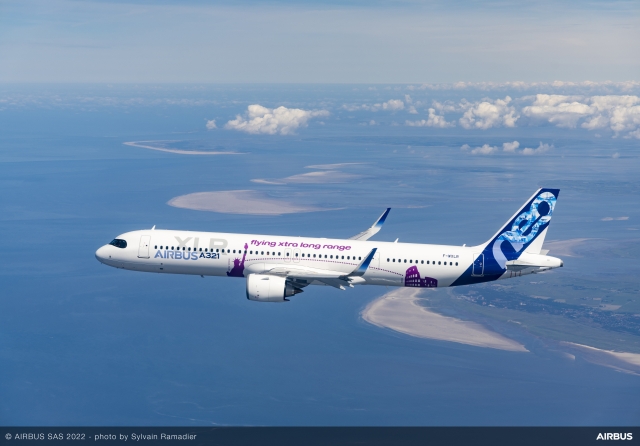
Christmas came early for Aer Lingus as the airline took delivery of its first two Airbus A321XLRs. Both aircraft were delivered to the airline on 18 December 2024 and arrived at Dublin from Hamburg-Finkenwerder.
The aircraft are registered EI-XLR (11348) and EI-XLT (11590) and are the first of six A321-200NYs the airline has planned. Aer Lingus is will utilize the type to new destinations in the United States with Nashville (TN) and Indianapolis (IN) being the first ones announced. These two new routes will launch in the 2025 summer season.
Next to its new two A321XLRs, the fleet of Aer Lingus is made-up of 27 A320s, six A320neos, eight A321-200NXs, three A330-200s, and ten A330-300s.
A happy moment for Airbus on 30 October 2024, as the manufacturer has officially delivered its very first A321XLR. The happy receiver of the aircraft is IAG, which has allocated it to Iberia where it will fly as EC-OIL (11504).
The A321-200NY can fly 15% further than the A321-200NX, enabling it to serve routes up to 8.700 km. Airbus flew the A321XLR for the first time on 15 June 2022, and received its type certification from the EASA on 19 July 2024.
According to Airbus, it has more than 500 firm orders for the newest version of the A321neo.
IAG has fourteen A321-200NYs on order. Eight of these will go to Iberia, while the other six are allocated to Aer Lingus.
From 6 November 2024, Iberia will deploy the type first from Madrid to London-Heathrow and Paris-Charles de Gaulle. From 14 November 2024, it will start using the type on long-haul flights to Boston (MA). Later next year, it will also serve Washington-Dulles (VA) with it
Airbus Prepares First Delivery Of A321XLR Aircraft For Spanish Airline Iberia
The long-awaited service entry of Airbus' next-generation game-changing narrowbody aircraft, the Airbus A321XLR, could be just around the corner, according to the latest reports from industry sources. Reuters indicated that the A321XLR will be delivered to Spanish flag carrier and Oneworld alliance member Iberia next Tuesday.
With a game-changing range of up to 4,700 nautical miles, the Airbus A321XLR could drastically change how airlines perform narrowbody operations and open up newer low-demand destinations across the globe. Dozens of A321XLRs have already been ordered, and the airline's decision to deliver its first plane to Iberia stands as a symbol of the manufacturer's relationship with the Spanish flag carrier. Iberia has not yet responded to requests for comment from Simple Flying and other media outlets regarding the matter.
On 6 April 2023, Icelandair announced it has signed a Memorandum of Understanding (MoU) with Airbus for an order for thirteen A321XLRs (A321-200NY). The deal also includes options for twelve additional XLRs. Deliveries of the new Airbuses is expected from 2029 onwards.
Icelandair, however, plans to begin Airbus-operations by 2025 as the airline is also in advanced negotiations with lessors to lease four A321LRs (A321-200NX).
The airline is planning to use the new A321neos as the replacement for its fleet of seventeen Boeing B757-200s, two B757-300s, and three B767-300ERs. In the press-release, it also stated it will continue to operate its B737MAXs, of which the fleet today consists of fourteen B737-8s and four B737-9s.
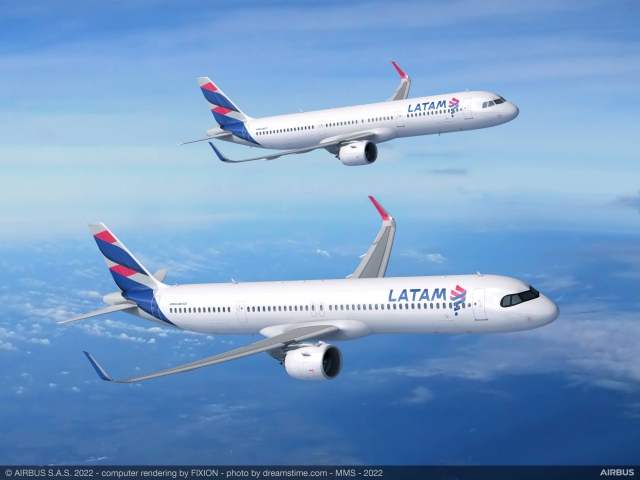
During the Farnborough Air Show in July 2022, LATAM announced it had ordered seventeen Airbus A321neos at Airbus and that the airline was planning to also introduce the A321XLR. Now, it seems these will be, at least partially, leased as well as LATAM and Air Lease Corporation signed a lease-agreement for five new A321XLRs.
The A321XLRs will be delivered between 2025 and 2026 and are coming from ALC's existing orderbook with Airbus. According to ALC's press-release, the aircraft are destined for LATAM Chile.
Air Transat is the newest customer for the largest-range variant of the Airbus A321neo, the A321XLR. The airline has signed a lease-agreement with Air Lease Corporation for three A321XLRs with an option on a fourth aircraft. The three aircraft are planned to be delivered at the end of 2025 and in 2026. If taken-up, the fourth aircraft could be delivered in 2027.
With an increased range of 15% compared to the A321LR (A321-200NX), the addition of the A321XLR will give the airline new options to reach more destinations with its narrowbody-fleet as the aircraft can fly up to 8,700 kms.
The new aircraft will join a fleet of seven A321-200s, twelve A321-200NXs, eleven A330-200s and one A330-300. Air Transat also has orders for seven additional A321LRs.
On 15 June 2022, the Airbus A321XLR took to the skies for the first time, kicking-off its flight test programme and road to certification. Airbus expects to have this finalized next year, with entry into commercial service in 2024.
On 15 June 2022, the latest version of the successful Airbus A320neo family, the A321-200NY, made its first flight. The Airbus A321-200NY is the long-range version of the A321-200neo and perhaps better known under its marketing name A321XLR.
The first prototype (msn 11000) took off from Hamburg-Finkenwerder at 11:05 hrs LT, and returned after a flight of 4 hours and 35 minutes. During this maiden flight, the aircraft’s flight controls and its CFM International Leap 1A engines were tested, as well as its flight envelope protections at high and low speeds.
Final assembly of two additional A321XLR test aircraft has already been completed. The second aircraft (msn 11058), powered by a Pratt & Whitney PW1100G engine, is now undergoing test equipment installation. The third aircraft (msn 11080), powered by Leap-1As, has likewise left the final assembly line and is being completed with a full cabin interior and test equipment.
The A321XLR will serve routes of up to 8,700km, 15% more than that of the A321-200NX (a version marketed as A321LR) which is equipped with additional fuel tanks and 97 tonnes maximum take-off weight (MTOW). To achieve this range, the changes on the A321XLR - compared to other version of the A321neo - include a new 12,900 litre permanent Rear Centre Tank (RCT) for more fuel, a modified and strengthened landing gear, a higher MTOW of 101 tonnes and an optimised single slotted wing-trailing-edge inboard flap configuration to preserve the same take-off performance and engine thrust requirements of other A321neo versions. The necessary structural enhancements for the higher MTOW of the A321XLR required a new aircraft type certificate and therefore it is officially designated as the A321-200NY.
At the moment of the first flight, Airbus has orders for 460 A321-200XLRs. The biggest customers are American Airlines and United Airlines, each with fifty A321-200XLRs on order.
Big Airbus Order As Qantas Greenlights Project Sunrise
After multiple diversions and delays, Qantas' ambitious Project Sunrise got the official green light on Monday morning (Sydney time). Qantas CEO Alan Joyce made the announcement in Sydney alongside a prototype Project Sunrise plane, an A350-1000 featuring Qantas livery specially flown in from Toulouse for the occasion.
From 2025, a fleet of 12 Airbus A350-1000s will fly nonstop from Australia's east coast to London and New York. In addition, Qantas confirmed an order for 40 new Airbus A321XLRs and A220s to fly domestic and short to medium-haul international routes, replacing existing aircraft, with the first due to land in 2023. Qantas has also secured options for a further 94 narrowbody Airbus jets spread over the next decade.
We have come through the other side of the pandemic a structurally different company. Our domestic market share is higher, and the demand for direct international flights is even stronger than it was before COVID. The business case for Project Sunrise has an internal rate of return in the mid-teens," said Mr Joyce in Sydney on Monday.
“The Board’s decision to approve what is the largest aircraft order in Australian aviation is a clear vote of confidence in the future of the Qantas Group. Our strategy for these aircraft will see us generate significant benefits for those who make it possible – our people, our customers, and our shareholders."
Pandemic throws Project Sunrise into disarray
The bold plan to link Australia's east coast cities to destinations on the other side of the world in a single hop was set to launch just before the pandemic derailed plans. Qantas had picked modified A350-1000s as its preferred aircraft and was just weeks away from confirming the aircraft order when COVID-19 turned everything upside down.
Qantas never gave up on Project Sunrise. Every six months or so throughout the pandemic, CEO Alan Joyce would bob up to remind everyone that nonstop flights to places like New York, Capetown, and London were still on the agenda. Indeed, Mr Joyce argued as the airline industry recovered from the pandemic, passengers would prefer to bypass transit ports, making the Project Sunrise business case even more compelling. But in the meantime, it was all a question of timing.
Keen plane spotters knew an aviation news story was brewing when an A350-1000 (registration F-WMIL), partly decked out in Qantas colors, took off from Toulouse (TLS) on April 30 and flew down to Perth (PER), landing there on Sunday evening. In the early hours of Monday morning, the jet departed Perth for the trip across to Sydney, where it landed around 60 minutes ahead of the big announcement. Interestingly, the jet didn't make the TLS - SYD flight in one hop, per Project Sunrise's top-selling point.
Project Sunrise locked in
In a hangar at Sydney Airport on Monday morning, Mr Joyce confirmed he'd signed on the dotted line with Airbus to take the12 Project Sunrise Airbus A350-1000 aircraft. Passengers embarking on the epic trips are in for a treat, with six fully enclosed first class suites featuring a separate bed and seats, lie-flat business class seats with sliding doors, and upgraded premium economy and economy class seats.
Although the A350-1000 is a sizable plane, Qantas' A350s will only carry 238 passengers, with more than 40% of the cabin dedicated to premium seating. This compares to more than 300 seats on competitor airlines. Each Project Sunrise aircraft will include a "wellness zone" where passengers can stretch their legs and get the blood flowing again.
"The A350 and Project Sunrise will make any city just one flight away from Australia. It’s the last frontier and the final fix for the tyranny of distance. As you’d expect, the cabin is being specially designed for maximum comfort in all classes for long-haul flying," said the Qantas CE0.
An Airbus focus for the future Qantas narrowbody fleets
While Qantas' order for the Airbus narrowbodies might not capture the headlines like the Project Sunrise jets, the new Airbus narrowbody order will have a greater impact on the airline's day-to-day operations. On Monday morning, Mr Joyce also confirmed firm orders for 20 Airbus A321XLR and 20 Airbus A220-300 aircraft to start replacing Qantas’ narrowbody Boeing 737 and 717 fleet.
The first A220s are due to land in late 2023 and the first A321XLRs are slated to start landing in late 2024. The 94 options are spread across A320 and A220 families, with significant delivery timing and aircraft type flexibility.
"The A320s and A220s will become the backbone of our domestic fleet for the next 20 years, helping to keep this country moving. Their range and economics will make new direct routes possible, including serving regional cities better," said Mr Joyce.
A big upgrade for future Qantas passengers
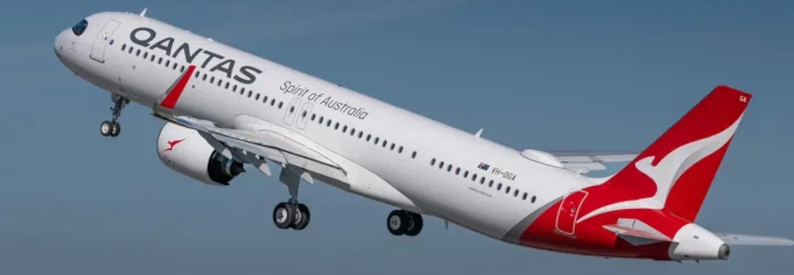
The Qantas’ A321XLR will be five meters longer than the outgoing 737s. The new jets will seat 200 people (20 in business class and 180 in economy class) – a 15% increase with no reduction in space between seats. The A321XLR can fly approximately 3,000 kilometers further than the 737-800s and opens up a wider range of direct domestic and short-haul international routes.
The incoming A220-300s are larger overall than the outgoing 717-200s and will be configured to seat 137 people (10 in business class and 127 in economy class) – a 25% increase with no reduction in space between seats. It has almost twice the range at over 6,000 kilometers, meaning it can fly between any city in Australia.
Most regular Qantas flyers will agree these new planes represent a significant upgrade. The Airbus order also locks in the Qantas drift away from Boeing in favor of the Toulouse plane builder. Airbus fans will appreciate that drift, Boeing fans maybe less so. But these incoming jets do represent a significant step-up in Qantas' future capabilities and combined with the Project Sunrise flights, sees Qantas chart its course over the medium-term future.
Aviation Capital Group Buys 20 Airbus A220s & 40 Airbus A320s
Airbus has notched one more order in the last hours of 2021. Lessor Aviation Capital Group has signed a deal for 40 A320neo family aircraft and 20 A220s, growing its fleet in the coming years. The order includes five A321XLRs, the plane set to reshape the long-haul market. Here’s a look at what could be the last order of the year.
ACG operates a diverse portfolio of Airbus aircraft, including the A320 and A330 families. Photo: Airbus
Last minute
Airbus announced a new order on 30th December, just before the books for the year close. This one came from Aviation Capital Group (ACG), a lessor owned by the Tokyo Century Corporation. The latest order will see ACG increase its Airbus commitments from 39 to nearly 100.
The order consists of two aircraft families. ACG has placed a firm order for 40 A320neo jets, of which five will be A321XLRs. The remaining 35 will be a mix of the standard A320 and A321neo jets, which the group already owns. ACG has also signed an MoU for 20 A220s, expanding its fleet size for the versatile regional jet.
Prior to the deal, ACG listed 39 firm commitments with Airbus and 17 with Boeing. The latest order means the European giant’s backlog is set to grow to 99, leaving the US-based firm far behind.
Riding the wave
For Airbus, the final hour deal wraps up an already strong year. The European aerospace firm has signed a series of deals since November. In a statement, CCO Christian Scherer said,
“The order is another gratifying endorsement of our single aisle products by one of the world’s premier aircraft asset managers, ACG and the Tokyo Century Group. It also forcefully confirms the A220 as a growingly desirable aircraft and investment in the commercial aviation landscape. We congratulate and thank ACG for its decision to select both the A220 and A320neo Families.”
ACG owns over 400 aircraft, 96% of which are narrowbodies, and have an average age of only 5.6 years. Photo: Airbus
The ACG deal comes two days after another major lessor deal. Air Lease Corporation added 116 planes to its order book, including 25 A220s, 79 A321neos (incl. 20 XLRs), and 12 widebodies. It’s been a good week for Airbus, to say the least.
Growing orders
After two years of uncertainty, aircraft manufacturers have bounced back in 2021. Airbus has certainly led the charge, with well over 500 deliveries in the first 11 months of the year and a series of important orders.
This includes the newly-launched A350F, which has attracted orders from carriers like Air France, Singapore Airlines, and lessors such as ALC and CMA CGM. The new aircraft type will help Airbus break into the freighter market and challenge Boeing’s long-standing supremacy thanks to the 747 and 777F programs.
The A350F is Airbus’ response to the 777F and future cargo competitors from the dominant Boeing. Photo: Airbus
While the sun is setting on 2021 (depending on where you are in the world), 2022 is looking like a strong year for aviation, with more orders and deliveries hopefully on the way!
Airbus Secures Qantas A321XLR & A220 Aircraft Commitment
Champagne corks are popping in Toulouse today after Airbus locked in a multi-billion dollar aircraft commitment from Qantas. In a major announcement on Thursday morning (Sydney time), Qantas said it would buy 40 aircraft from the A320neo and A220 families with options for a further 94 aircraft. Qantas and Airbus are expected to finalize the order by June 30, 2022.
Airbus has locked in an order from Qantas for 134 narrowbody planes. Photo: Qantas
Qantas to buy Airbus A321XLR and A220 aircraft
The first 40 aircraft will comprise 20 A321XLR (extra long-range) and 20 A220 planes. With the options on the table, Qantas will potentially take 134 new narrowbody Airbus aircraft over a ten-year delivery period.
Qantas says Airbus jets will deliver a fleet mix with better network choices and route economics. Pratt & Whitney GTF engines will power both aircraft types and deliver fuel savings of between 15-20%, contributing to Qantas’ broader emission reduction efforts.
“This is a long-term renewal plan with deliveries and payments spread over the next decade and beyond, but the similarly long lead time for aircraft orders means we need to make these decisions now,” said Qantas CEO Alan Joyce on Thursday.
“This is a clear sign of our confidence in the future, and we’ve locked in pricing just ahead of what’s likely to be a big uptick in demand for next-generation narrowbody aircraft.”
A bitter blow for Boeing
The order will allow Qantas to begin replacing its domestic Boeing 737-800 workhorse aircraft. The airline has 75 Boeing 737s flying passengers, the oldest of which have just turned 20. But over 20 of those 75 planes are 18 years or older. The A220 order will see Qantas’ 20 strong fleet of Boeing 717-200s also phased out.
The news will come as a bitter blow for Boeing. Qantas has long had a Boeing lean, having flown fleets of Boeing 717s, 737s, 767s, and 747s until recently. But Airbus has been making inroads into Boeing’s dominance at Qantas. Today’s announcement will see Qantas become a predominantly Airbus airline in the years to come.
Just last week, Alan Joyce argued Boeing was still in the race. “Qantas has Boeing 737s today, so it makes sense for us to stick with the Boeing aircraft,” he said at CAPA’s Asia-Pacific Aviation Summit. But he admitted he was also a fan of the narrowbody Airbus aircraft operated by low-cost subsidiary Jetstar. He called the A320neo and A321neo aircraft Jetstar has on order “amazing aircraft.”
“The A320 will be new for Qantas Domestic, but we already know it’s a great aircraft because it’s been the backbone of Jetstar’s success for more than 15 years and more recently operating the resources industry in Western Australia,” said Mr Joyce today.
A rendering of the Qantas A321XLR aircraft. Photo: Qantas
Boeing gets a nod, but no business, from Qantas
Boeing has spent much of 2021 restoring its order book to its normally healthy status. The US aircraft manufacturer will double the number of planes delivered this year compared to 2020. Securing an order from Qantas would have capped the year off nicely for Boeing.
Instead, Airbus has the opportunity to end 2021 on a high. In addition to locking in the Qantas business, Airbus is likely to emerge as the winner in the soon-to-be-announced fleet replacement order from the Air France-KLM Group.
On Thursday, Alan Joyce acknowledged the efforts of Airbus, Boeing, Embraer and the engine manufacturers to win the business.
“This was a very tough choice to make,” the Qantas CEO said. “Each option delivered on our core requirements around safety, capability and emissions reductions. But when you multiply even small benefits in areas like range or cost across this many aircraft and over the 20 years they’ll be in the fleet, Airbus was the right choice as the preferred tenderer.”
Boeing suffered a similar fate in the race to become the preferred Project Sunrise aircraft – close, but no banana.
Mr Joyce added the Airbus deal had the advantage of providing ongoing flexibility within the order. He says this allows Qantas to keep choosing between the entire A320neo and A220 families depending on its changing needs in the years ahead. The ability to combine the Jetstar and Qantas order for the A320 type was also a factor.
“The combination of small, medium, and large jets and the different range and economics they each bring means we can have the right aircraft on the right route.”
Qantas says it will make further announcements about the order over the coming months.
The Australian carrier said that it had selected Airbus after "a detailed review by the airline's engineering, flight operations, customer experience, network, fleet procurement and finance teams", following a Request for Proposals issued in October 2020. It also evaluated B737 MAX and E2 family aircraft.
"This was a very tough choice to make. Each option delivered on our core requirements around safety, capability and emissions reductions. But when you multiply even small benefits in areas like range or cost across this many aircraft and over the 20 years they'll be in the fleet, Airbus was the right choice as preferred tenderer," Chief Executive Alan Joyce said.
He underlined that one of the core advantages of Airbus was the flexibility related to the two types and multiple variants available to the airline. While the first batch will be firmed at twenty A220-300s and twenty A321-200NX(XLR)s, Qantas said that it retained the ability to adjust the types covered by the 94 purchase rights in the future. It underlined that the purchase rights could also include A220-100s. Joyce stressed that by placing the tentative commitment now, Qantas secured prices "just ahead of what's likely to be a big uptick in demand for next-generation narrowbody aircraft".
The Australian airline underlined that its new order - which is expected to be finalised by the end of June 2022 - will come on top of Qantas Group's existing order for A320neo Family aircraft for its low-cost carrier, Jetstar Airways. The airline has forty-five A320-200Ns, two A321-200Ns, twenty-six A321-200NX(LR)s, and thirty-six A321-200NX(XLR)s on firm order from Airbus. Its current narrowbody fleet is all-Airbus and comprises fifty-one A320-200s and six A321-200s.
Qantas said it had "exciting" plans for new cabins on board its A220 and A321-200NX(XLR)s. It will share the details "in coming months". The airline said it would use the A321neo to add capacity on high-demand trunk domestic routes, but their extended range will also allow Qantas to add new routes. In turn, it will use the A220s on off-peak trunk routes and on regional routes to add extra frequencies.
The aircraft deliveries are scheduled to begin between July 2023 and June 2024 and continue for over ten years. The order has yet to be approved by internal stakeholders, including unions and the carrier's Board of Directors.
Airbus has announced that its first A321XLR has entered final assembly at the plant at Hamburg-Finkenwerder. The aircraft, MSN 11000 is planned to have its first flight next year. For the certification process, it will be joined by MSNs 11058 and 11080. Airbus hopes to have the newest version of the A321 certified by 2023 with deliveries to customers starting in the same year.
Although Hamburg is the pilot-site for producing the A321XLR, Airbus has announced it will also built the aircraft at the other A320neo-family Final Assembly Lines, which are at Toulouse-Blagnac in France, Mobile (AL) in the US and Tianjin in China.
The A321XLR offers customers an extended range of 8,700 km, which is 1,296 km more than the A321LR. It can seat up to 244 passengers in a single class. So far, there are more than 450 XLRs ordered by 22 customers.
Airbus Is Putting The Final Touches On Its First A321XLR
Airbus’ first A321XLR has entered the final assembly phase in Hamburg. With manufacturer serial number 11000, the aircraft will act as a test and certification aircraft ahead of the type’s expected entry into service with Middle East Airlines in 2023. The first flight of the plane is expected next year.
Airbus has finished assembling the fuselage of the first A231XLR. Photo: Airbus
The Airbus A321XLR was an instant hit when launched at the 2019 Paris Air Show. According to data from ch-aviation.com, Airbus has clocked orders for almost 450 XLR aircraft since its launch. Before the European manufacturer can start delivering these planes, it must first get the type certified, as was the case with the other A321neo family aircraft that came before the XLR.
Of course, the first of any aircraft typically takes slightly longer to build. While Airbus will plan how to make the plane before starting the project, the processes are still yet to become fully established. Airbus wants to build the XLR across its four A320 family final assembly lines, and with this in mind, the company wants teams at all sites to learn from the experience of building the first aircraft.
The first “flight” of the A321XLR… Photo: Airbus
Stay informed:Sign up for our daily and weekly aviation news digests.
Ready to leave FAL Hangar Nine?
The manufacture of the first A321XLR has been taking place in Hangar Nine at the Airbus Hamburg site in Finkenwerder, Germany. According to the planemaker, the aircraft isn’t quite ready to leave the hangar just yer. While most of the aircraft has been built, a few steps remain.
Airbus intends to install a suite of flight test instruments into the aircraft to be used during the aircraft’s test phase. Simple Flying recently got a peek at what such instrumentation looks like on the Boeing 777X in Dubai. Additionally, Airbus still needs to install and test the CFM LEAP engines that will power the jet.
Airbus has updated the neo tail livery for the latest aircraft in the family. Photo: Airbus
Once the landing gear retraction mechanism has been tested, the aircraft will enter the paint shop to receive the final production touches before being handed over to the flight test team. Once the flight test team takes the plane, they will complete a series of ground checks to check that the aircraft operates as expected before it takes to the skies. The final step will see a first flight take part in 2022.
Once the A321XLR has completed its first flight, it will then go through a certification process with EASA and other significant bodies before the first aircraft is delivered to MEA. American Airlines also expects to take its first A321XLRs in 2023, followed by Frontier in 2024 and United Airlines in 2025.
As part of its restructuring, AirAsiaX and Airbus reached an agreement about the cancellation of 63 A330-900s and ten A321neoXLRs. According to the airline, 99% of its debt-holders has agreed to the restructuring, ensuring the airline will be able to survive.
The airline now has fifteen A330-900s and twenty A321neoXLRs remaining on order, which will be delivered in the coming years. AirAsiaX already has two A330-900s in the fleet, which are operated by Thai AirAsiaX
Airbus Seeks Compensation For Czech Airlines Unpaid A220 & A321XLR Orders
Czech Airlines (CSA), the flag carrier of the Czech Republic that is in bankruptcy proceedings, has a new creditor on its insolvency register: Airbus. Airbus wants almost CZK 17 billion ($815 million) for four A220-300 and three A321XLR aircraft that Czech Airlines ordered in 2019.
Czech Airlines was due to receive three A321XLRs. Photo: Airbus
Airbus is seeking financial compensation of CZK 17 billion
The flag carrier of the Czech Republic, Czech Airlines (CSA), could soon be facing a financial burden that it cannot possibly overcome.
Airbus is seeking as much as CZK 17 billion ($815 million) from the airline as part of the ongoing bankruptcy proceedings. The insolvency administrator, Michael Šefčík, is now assessing this claim, along with over 5,000 other ones.
The $815 million claim is for the unpaid order of seven aircraft that CSA made in 2019, but never ended up paying for. The seven aircraft are four A220-300s and three A321XLRs.
Czech Airlines also had four A220s on order. Photo: Airbus
What is Airbus claiming for?
In documents supplied as part of the bankruptcy proceedings for review by the insolvency administrator, and as seen by E15, Airbus is claiming CZK 8.5 billion ($407 million) of unconditional receivables from Czech Airlines.
This is exactly half of the total amount of $815 million that Airbus is claiming for. The other half is contingent receivables, so funds that Airbus wants Czech Airlines to pay if it withdraws from the purchase agreements made in 2019. The amount includes interest payments and arrears fees.
Given that it is certain that Czech Airlines will not be honoring the original purchase agreements since it has no financial means to do so, Airbus is really claiming for $815 million. This amount vastly outstrips the total value of CSA’s assets.
Czech Airlines already had a CZK 1.8 billion ($85 million) debt when it was placed in bankruptcy proceedings. If Airbus’ claim is approved, even partially, then Czech Airlines is almost certainly not going to succeed in its attempt to reorganize itself, and will definitely be shut down.
What order did CSA place in 2019 with Airbus?
In October 2019, when it was still a profitable airline, Czech Airlines ordered four Airbus A220-300 aircraft and simultaneously converted its order for three A320neo aircraft to three A321XLRs.
Petr Kudela, the Chairman of the Board of Czech Airlines, commented on the order at the time by saying:
“The A220 and A321XLR fit well with our long-term business strategy in terms of network expansion. These aircraft will definitely give Czech Airlines a competitive advantage, and will increase the capacity of our regular flights.”
But these seven aircraft never arrived. Czech Airlines, one of the world’s oldest airlines, may be destined for history books without ever having received them.
 Aer Lingus welcomes first 2 Airbus A321XLRs