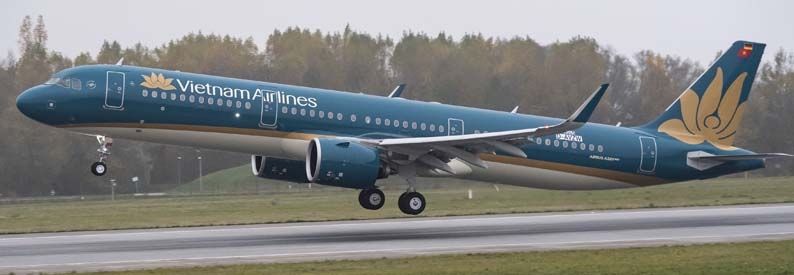
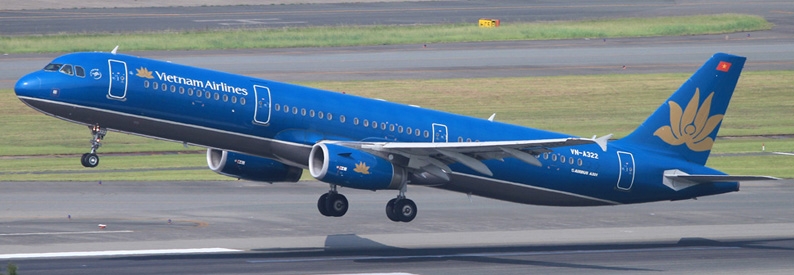
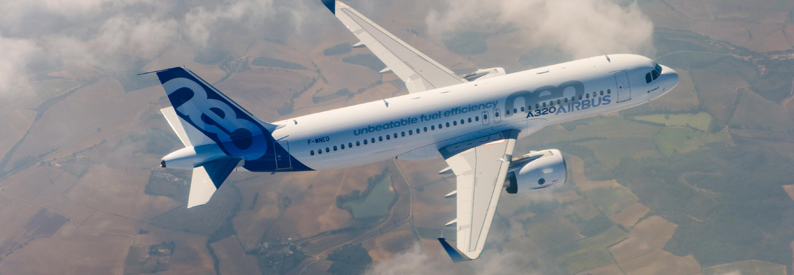
On 10 September 2026, the president of France and Vietnam held a summit in Paris to strenghten their economic ties. Part of the summit was the signing of two Memorandum of Understandings (MoU) by Vietravel and Vietnam Airlines with Airbus.
Vietnam Airlines agreed in the MoU to work on finalizing an order for five additional A350-900s. The new aircraft are planned to be delivered between 2033 and 2034. Today, the airline already operates fourteen of them.
Vietravel in its turn signed-up for 20 A220-300s and 30 A321neos, which will also include the A321XLR. Deliveries of this order is due to begin in 2029. Currently, it has a fleet of one A320 and four A321s.
Vietnam Airlines says the A320N types are part of its fleet modernisation and operational upgrade plans designed to meet rising travel demand, especially during the peak summer season. The aircraft, which seats 182 passengers in a two-class configuration, is expected to serve domestic routes such as Hanoi to Da Lat Cam Ly, Hanoi to Phu Quoc, Ho Chi Minh City to Thanh Hoa, and Ho Chi Minh to Tamky.
Vietnam Airlines says it also anticipates receiving two B787-10s in "the near future." The airline has four due and has previously confirmed two will arrive this year. It has struggled to secure enough aircraft to meet demand and replace those out-of-service due to the ongoing Pratt & Whitney engine issues. In addition to the two B787-10s and three A320neo, it has also recently relied on short-term wet-leased aircraft to boost capacity.
OE-IHW (msn 3966) was under conversion at the ST Engineering Aerospace facility at Singapore Seletar. It is the first of two converted freighters Swiftair will add to its in-house fleet. The second, OE-IHR (msn 3964), remains under conversion, the ch-aviation fleets module shows.
OE-IHW is set to be reregistered in Spain as EC-OHH. While its Austrian registration no longer appears in that country’s aircraft registry, the Spanish list is yet to be updated. It is a 14.92-year-old aircraft that only had one prior operator before being converted; it flew for Vietnam Airlines between December 2009 and November 2023.
EC-OHH is expected to enter into service in July, while the OE-IHR could do it in August, 2024, Swiftair confirmed to ch-aviation.
Hong Kong Airlines takes delivery of first A321-200
Hong Kong Airlines (HX, Hong Kong International) has taken delivery of an A321-200, the only example of the type in the operator's all Airbus fleet. B-LPR (msn 4315), formerly with Vietnam Airlines (VN, Hanoi Noi Bai International) as VN-A367, ferried into Hong Kong earlier this month on lease from AerCap, and is now undergoing maintenance checks before beginning revenue operations, expected to occur within the next month.
The A321 is expected to be put into service shortly. In addition, Hong Kong Airlines also recently signed deals to lease two more A320-200s. Both aircraft are expected soon. Earlier this month, ch-aviation reported on comments made by the carrier's Chairman, Sun Jianfeng, who said the airline expected to take delivery of eight aircraft this year, including A320, A321, and A330 types. He also said Hong Kong Airlines would take delivery of a similar number of aircraft over the next few years now it is profitable and has exited a restructuring phase. A Hong Kong Airlines spokesperson told ch-aviation that the airline expects to take delivery of a "few more"A321s this year.
Aside from B-LPR, Hong Kong Airlines operates a fleet of 27 aircraft, including twelve A320-200s, five A330-200s, and ten A330-300s. The airline flies to 31 airports in ten countries.
The aircraft are expected to deliver in 2024, meaning contracts would be signed through 2036. The carrier said a Request for Proposals with full specifications would be released between February 13 and February 17, 2023. It had not responded to ch-aviation's request for more details by the time of going to press.
The ch-aviation fleets advanced module shows that Vietnam Airlines currently operates forty-eight A321-200s and twenty A321-200Ns in terms of its narrowbody fleet. It retired the last of its eleven A320-200s in 2014 and has not operated A320ceo or neo since then. However, its subsidiary Pacific Airlines (BL, Ho Chi Minh City) (formerly known as Jetstar Pacific) has an in-house fleet of thirteen A320-200s, which are 8.8 years old on average.
Separately, the airline issued a tender for the appraisal of three of its oldest A321s of the 2007 vintage, indicating its intention to sell the aircraft. The carrier did not identify the specific units in the RFP - it currently operates six A321-200s delivered in 2007.
"We are acquiring two A321s from them. We're converting them to freighters, and we're leasing them back to them," ATSG's Chief Executive and President Rich Corrado said during the holding's quarterly earnings call.
Chief Commercial Officer Mike Berger added that the aircraft will redeliver to Vietnam Airlines in 2023. ATSG did not reveal the STC to be used.
The ch-aviation fleets advanced module shows that Vietnam Airlines operates forty-eight A321-200s, of which all but three are owned by the carrier. The airline is in the process of a gradual rollover to an A320neo Family narrowbody fleet. According to its Request for Proposals from January 2022, the two converted A321-200s will be of 2007 vintage of which six of the carrier's A321s were built in that year. Vietnam Airlines did not respond to ch-aviation's request for specific identification of the two airframes.
The Vietnamese flag carrier does not currently operate any dedicated freighters.
The lessor focuses on the B767 and B777 Families and owns a small portfolio of narrowbody aircraft, comprising four B757-200(C)s placed with ATI and four A321-200s under conversion (two have been earmarked for Malaysia's Raya Airways (TH, Kuala Lumpur Subang)).
Vietnamese flag carrier Vietnam Airlines says it is preparing to auction off 11 Airbus A321 CEO aircraft that have been in service with the airline for more than 12 years. In a move aimed at countering a loss of revenue brought about by the COVID-19 pandemic, the state-owned carrier plans to sell the planes later this year to increase its cash flow.
Vietnam Airlines is getting rid of some of its older Airbus A321s. Photo: Getty Images
Under the pretext of modernizing its fleet, this is not the first time that Vietnam Airlines decided to sell aircraft to replenish its coffers. In 2019 it put five Airbus A321-200CEO aircraft up for sale. A year later, it repeated the move, placing a further nine Airbus A321CEO planes up for sale.
Vietnam Airlines had a disastrous Q1
Under the pressure of being delisted from the Ho Chi Minh Stock Exchange, the Hanoi-headquartered airline posted its largest-ever quarterly loss in the first three months of 2021. The SkyTeam member airline lost VND4.97 trillion ($216 million) in Q1 2021, pushing its accumulated debt to VND14.22 trillion ($620 million), which is slightly over its charter capital.
Vietnam Airlines sold A321s in 2019 and 2020. Photo: Getty Images
According to ch-aviation, Vietnam Airlines currently has 49 Airbus A321-200s, of which 27 are active while 22 are being stored. The rest of Vietnam Airlines’ fleet is comprised of the following aircraft:
2 x Airbus A320neos
20 x Airbus A321neos
14 x Airbus A350-900s
7 X ATR 72-500s
4 x Boeing 787-10s
11 x Boeing 787-9s
Selling the planes makes sense
Providing they can get a good price for the older planes they plan to auction off, it is probably a good move, and as we can see from the airline’s fleet, 22 Airbus A321 CEOs are in storage. As for the IATA Travel Pass, it’s a no-brainer and will allow Vietnam to get its all-important tourism sector back up and running.
Vietnam Airlines Takes Delivery Of Its First A320neo
The newest addition to Vietnam Airlines’ fleet has arrived. The first of three A320neos due has landed in Vietnam. The plane, VN-A513, comes via ICBC Aviation Leasing. It is the first A320neo across the wider Vietnam Airlines fleet. The plane will slot in alongside the airlines’ narrowbody fleet of 70 Airbus A321s.
Vietnam Airlines has just received its first A320neo. Photo: Getty Images
A sudden shift in fortunes for Vietnam Airlines
The deal for the A320neos was signed in June 2019. At the time, Vietnam Airlines was flying high. Revenues and profits were higher than predicted on the back of an aviation boom in the country. Times were good, and Vietnam Airlines was eyeing expansion plans and further growth.
Vietnam Airlines stopped flying entirely in March and April. That caused revenues to dry up, and the airline struggled to meet outgoings. By May, some of its domestic flights were back in the air. But the schedules were a fraction of what they formerly were. On the Hanoi – Ho Chi Minh route, usually one of the world’s busiest, Vietnam Airlines was operating just 23 flights per day.
Meanwhile, Vietnam Airlines’ international flights were suspended back in March. 2020 was shaping as a serious challenge for an airline that was previously growing at a rapid clip.
After earning US$4.3 billion in the 2019 financial year, Vietnam Airlines is now flagging losses around US$655 million this year.
Vietnam Airlines in “really bad” trouble says chief accountant
Earlier this month, Airways Magazine had Vietnam Airlines’ chief accountant, Tran Thanh Hien saying the airline was in “really bad” financial trouble. The airline was having difficulty meeting day-to-day expenses such as salaries and ground handling fees.
The airline wants a loan from the Vietnamese Government. But Tran Thanh Hien says it’s not a loan – it’s an investment that will get paid back. Since you were asking, the airline would like at least half a billion US dollars to tide it over.
Vietnam Airlines is predominately a state-owned carrier. The Vietnamese Government has an 81.6% stake in the airline, and the Prime Minister personally oversees who gets appointed to the airline’s board. So, it’s a bit like swallowing your pride and going to have an uncomfortable chat with Dad.
Japanese airline, All Nippon Airways, also owns nearly 9% of Vietnam Airlines.
“Without the support, we will be in an extremely difficult situation at the end of August,” Vietnam Airlines CEO, Duong Tri Thanh, said earlier this month.
Vietnam Airlines is in serious financial strife and requires financial assistance from the Vietnamese Government. Photo: ASM-vwiki via Wikimedia Commons
Government funding will come at what cost?
In fairness, Vietnam Airlines isn’t the only airline asking their respective government for financial help. Multiple airlines around the world are doing so and most devoutly promise to square up down the track.
While the Vietnamese Government hasn’t said no, it has previously expressed a desire to scale down its stake in Vietnam Airlines. They want to reduce their stake to 51%. That’s enough to maintain a controlling interest but also enough to share the pain when that rolls around.
The Vietnamese Government also appears keen to slow down the pace of aviation growth in Vietnam. They’ve already put a halt on issuing licenses to prospective new airlines until 2022. No doubt, they’ll come up with something for Vietnam Airlines. The question is, at what cost to the airline?
Meanwhile, Vietnam Airlines’ shiny new A320neo is poised to begin flying around the country. But with over half the airline’s fleet grounded, it arrives at the worst possible time.
Vietnam Airlines (VN, Hanoi) has announced a Request For Proposals (RFP) for the wet-lease of one A321-200 for six months, tentatively starting in December 2019.
The carrier did not disclose any further details via its official procurement website.
The airline has recently put up for sale five A321-200s, namely VN-A344 (msn 2255), VN-A345 (msn 2261), VN-A347 (msn 2267), VN-A348 (msn 2303), and VN-A349 (msn 2480). All five units have been inactive since late August or early September 2019, Flightradar24 ADS-B data shows.
In mid-October, the airline announced an RFP for the wet-lease of three A321-200s for two months starting that month. The deadline for offers passed on October 25. It is unclear if Vietnam Airlines selected any offers.
Having ended A320ceo operations back in 2013, Vietnam Airlines' mainline narrowbody fleet currently consists of fifty-three A321ceo and eleven A321neo.
As previously reported, it is currently in the process of finalising its investment plan for up to 100 more narrowbody aircraft for delivery in 2021-2025.
The proposal, which includes 50 firm aircraft and ten spare engines, is currently before the State Capital Management Committee awaiting consent. No mention of whether the order will focus on the A320neo family or B737 MAX has yet been made.
Vietnam Airlines (VN, Hanoi) has taken delivery of its first A321neo following the handing over of VN-A618 (msn 8589) on Wednesday, November 13. The twinjet is the first of six on longterm lease from Aviation Capital Group and sourced from the lessor's Airbus order book.
Nguyen Thai Trung, the airline's Deputy General Director, said the aircraft would be deployed on domestic flights as well as services to Indochina and Southeast Asia.
"The A321neo will really be a breakthrough for Vietnam Airlines," he said.
According to the ch-aviation fleets module, the jets are powered by Pratt & Whitney PW1130G-JMs engines.
Vietnam Airlines is an existing operator of the A321ceo of which it employs 57.
Vietnam Airlines has signed a Memorandum of Understanding (MOU) with Airbus for 10 more A350-900 aircraft. The aircraft will be used by the airline on non-stop flights to the US, beginning with services between Ho Chi Minh City and Los Angeles.
The MOU was signed in Hanoi today by Duong Tri Thanh, President and CEO of Vietnam Airlines, and Fabrice Brégier, Airbus President & CEO. The signing took place during the state visit to Vietnam of François Hollande, President of France, and was witnessed by Mr Hollande and Tran Dai Quang, President of the Socialist Republic of Vietnam.
Vietnam Airlines last year became the first airline in East Asia and the second in the world to operate the A350 XWB. The carrier already has four aircraft in service, with another 10 on firm order for future delivery. The additional 10 aircraft covered by today’s MOU will enable Vietnam Airlines to operate non-stop to the US West Coast, carrying 305 passengers in a three class premium layout.
“The intention to acquire these additional aircraft reflects our excellent experience with the A350 since it entered service with Vietnam Airlines last year,” said Duong Tri Thanh, President and CEO of Vietnam Airlines. “With its very long range capability, economic fuel consumption and spacious cabin, the A350 is the suitable aircraft for our proposed intercontinental routes to Europe and the US. The start of non-stop transpacific services with the A350 is yet another example of the commitment we have at Vietnam Airlines to strengthen our position as one of the world’s leading international carriers.”
“Today’s agreement further consolidates the A350’s position as the new long haul leader in the mid-size widebody category,” said Fabrice Brégier, Airbus President and CEO. “The A350 XWB has quite simply set new standards in its class, combining unbeatable operating economics with the highest levels of passenger comfort. We look forward to working closely with Vietnam Airlines as it continues to develop its long haul network and strengthens its position in the premium market.”
The all-new A350 XWB features the latest aerodynamic design, carbon fibre fuselage and wings, plus fuel-efficient Rolls-Royce Trent XWB engines. Together, these latest technologies translate into unrivalled levels of operational efficiency, with a 25 per cent reduction in fuel burn and emissions, and significantly lower maintenance costs. For passengers, the A350 XWB sets new standard in terms of in-flight comfort, with an extra-wide cabin offering more personal space in all classes, including 18 inch wide seats as standard in economy class.
To date, Airbus has recorded a total of 810 firm orders for the A350 XWB from 43 customers worldwide, already making it one of the most successful widebody aircraft ever. A total of 36 A350 XWBs have been delivered so far and the aircraft is now in service with eight carriers, including Vietnam Airlines.
Vietnam Airlines has become the second airline in the world to operate the all-new A350 XWB, following a special ceremony in Toulouse today. The A350-900 aircraft was delivered to global lessor AerCap on lease to the airline for operation on long haul routes and is scheduled to arrive in Hanoi tomorrow. Altogether, Vietnam Airlines is set to acquire 14 A350 XWBs, including 10 ordered from Airbus and four from lessors.
Vietnam Airlines will inaugurate commercial service with the A350 XWB later this week, initially on the Hanoi-Ho Chi Minh domestic sector and then on non-stop flights from Hanoi to Paris. The aircraft is configured with a premium three class layout, with 29 seats that convert to full flat beds in Business Class, 45 seats in Premium Economy and 231 in Economy. In addition to more personal space in all classes, the aircraft features the latest in-flight entertainment and connectivity systems throughout.
Vietnam Airlines’ new A350 XWB will join an existing Airbus fleet of 59 aircraft flying with the carrier, comprising 49 A321s and 10 A330s.
“The arrival of the A350 XWB marks the start of a major upgrade of our long haul fleet,” said Trinh Ngoc Thanh, Executive Vice President, Commercial, Vietnam Airlines. “Combining the latest technologies, a wider cabin and the highest levels of comfort, the A350 XWB will enable us to fly our passengers in style whichever class of travel they choose. We are proud to be the second airline in the world to receive the A350 XWB aircraft which is a step forward that helps us to fulfil our commitment to “reach further”.”
“AerCap is pleased to be the first leasing company to take delivery of the A350 XWB directly from Airbus,” said Philip Scruggs, President & Chief Commercial Officer, AerCap. “We believe that the A350 XWB is an excellent addition to the Airbus family of aircraft. It incorporates the latest technology in both airframe and engines and will deliver important operating efficiencies to our airline customers. We are pleased to be leasing our first A350 XWB to Vietnam Airlines, which is one of the most vibrant airlines in Asia.”
“We are proud to see Vietnam Airlines become the second airline in the world to operate the A350 XWB,” said Fabrice Brégier, President and CEO, Airbus. “We are confident that the all-new A350 XWB will enable Vietnam Airlines to consolidate its position as one of Asia’s leading international carriers, bringing its passengers the best the industry has to offer.”
“We also thank AerCap for its ongoing confidence in our products and endorsement of their long term investment value,” added Mr Brégier. “The delivery of the A350 XWB for Vietnam Airlines marks a new milestone in our excellent partnership with AerCap, together offering a wide range of modern and cost-efficient fleet solutions for airlines in every market segment.”
AerCap is Airbus’ largest customer, and has ordered a cumulative total of 945 Airbus aircraft over the years. These include firm orders for a total of 20 A350 XWBs.
The A350 XWB features the latest aerodynamic design, carbon fibre fuselage and wings, plus new fuel-efficient Rolls-Royce Trent XWB engines. Together, these latest technologies translate into unrivalled levels of operational efficiency, with a 25 per cent reduction in fuel burn and emissions, and significantly lower maintenance costs.
To date, Airbus has recorded a total of 781 firm orders for the A350 XWB from 40 customers worldwide, already making it one of the most successful widebody aircraft ever. The aircraft handed over today is the fifth A350 XWB to be delivered, following the type’s entry into commercial service with its first operator earlier this year.
The first A350 XWB for Vietnam Airlines has completed its first flight in Toulouse yesterday bearing the airline’s distinctive blue and gold lotus livery. The aircraft will now enter the final phase of production, including cabin completion, as well as further ground and flight tests. The aircraft, which will be leased from AerCap, is scheduled for delivery in the middle of the year.
Vietnam Airlines will become the first Asian airline to fly the A350 XWB and the second operator in the world. Vietnam Airlines will acquire 14 A350 XWBs, including ten on order from Airbus and four under lease agreements. The carrier will operate its A350 XWB fleet on premium long haul routes, beginning with services between Hanoi and Paris.
The A350 XWB is Airbus’ all-new mid-size long range aircraft family and the newest member of Airbus' leading widebody family. The A350 XWB is the world’s most modern and efficient aircraft family, setting new standards in terms of flight experience for passengers, operational efficiency and cost-effectiveness for airlines. The A350 XWB had received 780 Firm orders from 40 customers at the end of April 2015.