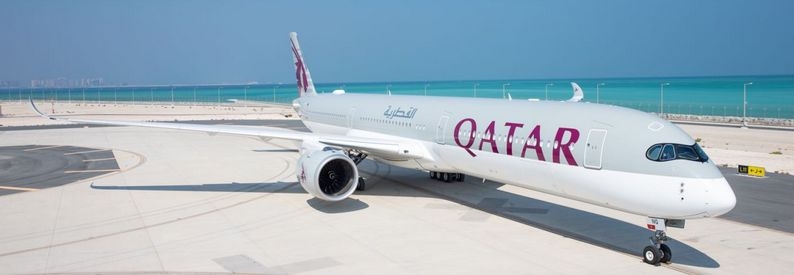
"We have sadly failed in all our attempts to reach a constructive solution with Airbus in relation to the accelerated surface degradation condition adversely impacting the A350 aircraft. Qatar Airways has therefore been left with no alternative but to seek a rapid resolution of this dispute via the courts," Qatar Airways said in a statement.
The carrier has stressed that it is primarily seeking to force Airbus to "address [Qatar Airways'] legitimate concerns without further delay". It called for a thorough investigation to establish the root cause of the defects, necessary for any effective remedy.
Airbus said that it had been served with court papers and was analysing their contents. It stressed that it would "vigorously defend" its position.
Qatar Airways was forced to ground twenty-one A350s by the Qatari Civil Aviation Authority over paint degradation. Airbus, backed by the European Union Aviation Safety Agency (EASA), claims the defects are not structural and have no impact on safety. Other carriers have also reported similar defects on their A350s, albeit to a lesser degree. No other airline or regulator has, however, grounded the type.
Qatar Airways operates thirty-four A350-900s (including sixteen grounded units) and nineteen A350-1000s (five grounded), the ch-aviation fleets advanced module shows. The airline has a further twenty-three A350-1000s on firm order but paused all future deliveries pending the resolution of the current dispute.
Airbus Firms Up A350F Order With Cargo Powerhouse CMA CGM
French shipping and logistics company CMA CGM has given its official seal of approval to the Airbus A350F aircraft by placing a firm order for four freighters. This is in continuation to the Memorandum of Understanding (MoU) signed by the company with the planemaker last month. The news signals a growing interest among airlines and freight organizations for the A350F and Airbus’ attempt to capture a substantial slice of the expanding air cargo business.
Firm order
The last couple of years have tested the aviation sector like no other in living memory. With many airlines hanging by a thread during the peak of the pandemic, it was cargo that raked in the much-needed capital to keep operations afloat. It’s no surprise then that many airlines are now reshaping and consolidating their long-term cargo strategies. And Airbus seems to have sniffed the demand.
In a statement on December 20th, the European planemaker officially announced firming up an order to purchase four A350F freighter aircraft with the CMA CGM Group. This will take the company’s total Airbus fleet to nine, which includes four A330-200Fs and one A330-200 that will be converted into a freighter.
The present order will take CMA CGM’s Airbus fleet to nine. Photo: Airbus
While it’s still early days to reach any firm conclusions, Airbus seems to have come up with a competitive freight product, enough to hold the attention of various airlines. The aircraft manufacturer explained in a statement what exactly makes the A350F more efficient than its competitors in the market, such as the 777F, saying,
“Over 70% of the airframe is made of advanced materials resulting in a 30t lighter take-off weight, generating an at least 20% lower fuel burn over its current closest competitor. With a 109t payload capability (+3t payload/ 11% more volume than its competition), the A350F serves all cargo markets (Express, general cargo, special cargo…) and is in the large freighter category the only new generation freighter aircraft ready for the enhanced 2027 ICAO CO₂ emissions standards.”
Busy year ahead
Releasing its November figures earlier this month, Airbus announced 318 new orders, many of which were revealed at the Dubai Air Show. With gross orders of 610 aircraft so far this year, the demand for new aircraft signals that airlines are ready to emerge out of the pandemic or evolve to operate in a post-COVID world.
Before the A350F, Airbus didn’t offer any substantial competition to Boeing’s line of freighter airplanes. Its paint issues notwithstanding, many airlines seem ready to invest in the freighter version of the A350 for their long-term cargo operations.
Air France has also issued a Letter of Intent for four A350Fs. Photo: Airbus
Apart from CMA CGM, other firms that have shown interest in the aircraft include American aircraft leasing company Air Lease Corporation (ALC), placing an order for 7 A350Fs, with Singapore Airlines and Air France issuing Letters of intent for 7 and 4 A350Fs, respectively. Qatar Airways, however, is not too gung-ho about the A350F (unsurprisingly), with CEO Akbar Al Baker confirming his lack of interest in the aircraft and eyeing the Boeing 777XF instead.
Japanese low-cost carrier Peach Aviation has become the first in the country to take delivery of the Airbus A321LR. The ANA subsidiary is looking to switch to a modernized fleet by 2025, supported by the A320neo and A321LR. The aircraft will enter service on 18th Jan on a popular domestic route.
The first Peach A321LR landed in Osaka’s Kansai International Airport on Sunday night. Photo: Peach Aviation
Ready to go!
Peach took delivery of its first of six A321LRs (Long Range) on Sunday, bringing the airline closer to its sustainability goals. The new aircraft boasts a 20% efficiency gain due to the newer LEAP-1A engines compared to the A320ceo. While the plane isn’t planning on making any long-haul trips soon, it will increase Peach’s potential market in the coming years.
For passengers, the A321LR brings a host of new benefits. Each seat offers 30-31″ of seat pitch, standard for low-cost carriers and even some full-service ones now. However, the airline notes that its layout allows for 1″ extra of width in every seat, a notable increase. The aircraft can carry 218 passengers in a 3-3 layout.
The cabin also features in-seat power through a USB outlet, a nice touch for the short flights the airlines currently operators. While a power outlet is ideal for passengers, USB plugs can ensure passengers aren’t left without power while streaming content using the inflight network. Peach doesn’t offer IFE, similar to other budget airlines.
More destinations
Peach’s A321LR, JA901P, will enter service in January 2022 and will be the first Japanese airline to operate the long-haul, narrowbody jet. With a range of 7,400km, the aircraft can fly into the entirety of Asia and even as far as Honolulu, Hawaii. This opens a range of future destinations for Peach as more aircraft enter service.
The A321LR is scheduled to start service on 18th Jan between Osaka and Okinawa. Osaka’s Kansai airport is the airline’s main hub since commencing operations in 2012. The coming months will see the A321LR begin flying between the pair above and Sapporo (New Chitose Airport).
While the A321LR is not cleared for ETOPS with Peach, the aircraft is already flying transatlantic for carriers in Europe. Given this, flights to major destinations like Honolulu from smaller Japanese cities could be possible. Expect to see more on such routes in the coming months and years as the remaining five A321LRs join the fleet.
The jet is the first of 11 such aircraft due to be leased by Breeze Airways from AerCap. The second is slated for delivery by the end of the month, with the remaining nine due in 2022-2023. Breeze Airways will lease a further three A220-300s from Einn Volant Aircraft Leasing Holdings Limited, a joint venture between AerCap and the Caisse de dépôt et placement du Québec investment firm. The three jets will be managed by AerCap and will deliver in 2022.
The airline will deploy the A220s in a premium-heavy configuration with 36 business and 90 economy class seats (including ten with extended legroom). It has yet to file schedules for the type but said previously that it would begin their commercial operation in the first half of 2022.
The Air France-KLM Group has become Airbus’ latest conquest this week, as the planemaker has snagged another significant order from the European group. In total, the group ordered 100 A320neo family aircraft for KLM and the two Transavias, with options for 60 more. In a surprise move, the group has also signed up for four A350F for Air France, with options on a further four.
A bumper order for Airbus today from the Air France-KLM group. Photo: Airbus
Airbus bags Air France-KLM for order hat trick
It’s been a good week for Airbus, as the planemaker has today snagged a third significant order in close succession. Following the Singapore Airlines order for the A350F earlier this week, and today’s news of a forthcoming order from Qantas, Airbus is shoring up its position closer to home too, with an order from Air France-KLM.
The European planemaker was pegged as the front runner for the group’s fleet renewal for some time, following the issuance of a tender earlier this year. The tender was to expand and renew the short-haul fleet of Dutch airline KLM, as well as to update the fleet of both French and Dutch branches of Transavia.
Today, the Air France-KLM group has announced a firm order for 100 A320neos alongside purchase rights for an additional 60 aircraft. The order covers Airbus A320neo and Airbus A321neo aircraft. The first deliveries are expected in the second half of 2023. The group stated that these aircraft will operate medium-haul routes in Europe, notably from Amsterdam-Schiphol – KLM’s global hub and Transavia Netherlands’ main base, and from Paris-Orly, Transavia France’s main base.
The A350F as well
It seems Airbus is keen to push its A350F to new customers, with the airline group also signing a letter of intent (LOI) for four of the freighter jets. Added to this is a purchase right for another four A350Fs, all headed for the Air France fleet.
Christian Scherer, Airbus Chief Commercial Officer and Head of Airbus International commented,
“We are honoured with Air France-KLM Group’s foresight, after an in-depth evaluation, to acquire the latest generation Airbus A320neo Family aircraft and A350F to modernise its European medium, short-haul, and cargo fleets. This milestone decision shows again that an aircraft’s value lies primarily in performance, reliability, fuel efficiency and reduced CO2 emissions, all criteria in which the Airbus product line excels. We are very proud to be awarded this decision and to be part of the future of these iconic airlines, Air France, KLM and Transavia.”
The group has also signed up for the A350F. Photo: Airbus
The choice of Airbus will be a kick in the teeth for Boeing, as all are Boeing narrowbody customers at present. KLM flies 47 737NGs for its short-haul needs, which average almost 15 years of age across the fleet. Transavia has 39 737s, averaging 11.8 years of age, while Transavia France has 54 737-800s with an average age of 9.1 years. None of these airlines presently fly the A320 family of jets.
What a week for Airbus
Airbus is having an excellent close to the year, with significant order news coming in left, right and center. Just yesterday, Singapore Airlines signed a commitment for seven A350F, the new freighter variant of Airbus’ popular widebody plane. SIA becomes the third customer for the new cargo plane, after ALC booked an order at the Dubai Air Show, and CMA CGM followed it up with an MoU for four.
Singapore Airlines has signed a letter of intent to purchase seven Airbus A350 freighters. Photo: Airbus
Earlier today, news came in from Qantas that Airbus was the chosen supplier for its future narrowbody fleet. The Australian flag carrier intends to purchase 40 aircraft from both the A320neo and the A220 families and wants to hold options for a further 94. Although the deal is not expected to be formally announced until June next year, it’s still a major feather in the cap of the European planemaker.
Adding Air France-KLM to Airbus’ order hat trick today really is the icing on the cake. Although the planemaker is looking likely to miss its 2021 delivery target by some measure, things are beginning to look up as the year draws to a close.
Airbus Secures Qantas A321XLR & A220 Aircraft Commitment
Champagne corks are popping in Toulouse today after Airbus locked in a multi-billion dollar aircraft commitment from Qantas. In a major announcement on Thursday morning (Sydney time), Qantas said it would buy 40 aircraft from the A320neo and A220 families with options for a further 94 aircraft. Qantas and Airbus are expected to finalize the order by June 30, 2022.
Airbus has locked in an order from Qantas for 134 narrowbody planes. Photo: Qantas
Qantas to buy Airbus A321XLR and A220 aircraft
The first 40 aircraft will comprise 20 A321XLR (extra long-range) and 20 A220 planes. With the options on the table, Qantas will potentially take 134 new narrowbody Airbus aircraft over a ten-year delivery period.
Qantas says Airbus jets will deliver a fleet mix with better network choices and route economics. Pratt & Whitney GTF engines will power both aircraft types and deliver fuel savings of between 15-20%, contributing to Qantas’ broader emission reduction efforts.
“This is a long-term renewal plan with deliveries and payments spread over the next decade and beyond, but the similarly long lead time for aircraft orders means we need to make these decisions now,” said Qantas CEO Alan Joyce on Thursday.
“This is a clear sign of our confidence in the future, and we’ve locked in pricing just ahead of what’s likely to be a big uptick in demand for next-generation narrowbody aircraft.”
A bitter blow for Boeing
The order will allow Qantas to begin replacing its domestic Boeing 737-800 workhorse aircraft. The airline has 75 Boeing 737s flying passengers, the oldest of which have just turned 20. But over 20 of those 75 planes are 18 years or older. The A220 order will see Qantas’ 20 strong fleet of Boeing 717-200s also phased out.
The news will come as a bitter blow for Boeing. Qantas has long had a Boeing lean, having flown fleets of Boeing 717s, 737s, 767s, and 747s until recently. But Airbus has been making inroads into Boeing’s dominance at Qantas. Today’s announcement will see Qantas become a predominantly Airbus airline in the years to come.
Just last week, Alan Joyce argued Boeing was still in the race. “Qantas has Boeing 737s today, so it makes sense for us to stick with the Boeing aircraft,” he said at CAPA’s Asia-Pacific Aviation Summit. But he admitted he was also a fan of the narrowbody Airbus aircraft operated by low-cost subsidiary Jetstar. He called the A320neo and A321neo aircraft Jetstar has on order “amazing aircraft.”
“The A320 will be new for Qantas Domestic, but we already know it’s a great aircraft because it’s been the backbone of Jetstar’s success for more than 15 years and more recently operating the resources industry in Western Australia,” said Mr Joyce today.
A rendering of the Qantas A321XLR aircraft. Photo: Qantas
Boeing gets a nod, but no business, from Qantas
Boeing has spent much of 2021 restoring its order book to its normally healthy status. The US aircraft manufacturer will double the number of planes delivered this year compared to 2020. Securing an order from Qantas would have capped the year off nicely for Boeing.
Instead, Airbus has the opportunity to end 2021 on a high. In addition to locking in the Qantas business, Airbus is likely to emerge as the winner in the soon-to-be-announced fleet replacement order from the Air France-KLM Group.
On Thursday, Alan Joyce acknowledged the efforts of Airbus, Boeing, Embraer and the engine manufacturers to win the business.
“This was a very tough choice to make,” the Qantas CEO said. “Each option delivered on our core requirements around safety, capability and emissions reductions. But when you multiply even small benefits in areas like range or cost across this many aircraft and over the 20 years they’ll be in the fleet, Airbus was the right choice as the preferred tenderer.”
Boeing suffered a similar fate in the race to become the preferred Project Sunrise aircraft – close, but no banana.
Mr Joyce added the Airbus deal had the advantage of providing ongoing flexibility within the order. He says this allows Qantas to keep choosing between the entire A320neo and A220 families depending on its changing needs in the years ahead. The ability to combine the Jetstar and Qantas order for the A320 type was also a factor.
“The combination of small, medium, and large jets and the different range and economics they each bring means we can have the right aircraft on the right route.”
Qantas says it will make further announcements about the order over the coming months.
And just like that, it’s over. Emirates has taken delivery of its 123rd Airbus A380 order, bringing the entire double-decker jet program to a close. The Dubai-based airline was the first to place an order for the A380, then called the A3XX, way back at the 2,000 Farnborough Airshow, and has since grown to be the A380’s largest customer.
Emirates has taken delivery of the last Airbus A380. Photo: Emirates
The Airbus A380 first joined the Emirates fleet in 2008, and in the years since, has been used for more than 380,000 flights according to schedule data provided by Cirium. With two of the airline’s A380s already being retired, Emirates now has a fleet of 121 A380s. Earlier this year the airline revealed that one of those retired, its first-ever A380, has been dismantled.
The final delivery
Today was a bittersweet day for Emirates and Airbus. While new aircraft deliveries are usually cause for celebration, the end of an aircraft program is a somber occasion. This seems to be especially the case for the Airbus A380, a jet loved by passengers, but not so much by airlines.
The aircraft delivered to Emirates today will be registered as A6-EVS and will be delivered with the new Emirates premium economy cabin. The aircraft is only the 254th A380 to be built by the European planemaker, though it has the serial number 272.
Emirates was by far the Airbus A380’s biggest customer. Photo: Getty Images
The difference in the two numbers is primarily explained by canceled orders. Orders were assigned a place in the queue, and thus an MSN. However, when they were canceled, the queue was shuffled forwards, but not the serial numbers allocated. For example, according to Planespotters.net, MSN 37 was due to go to FedEx, while 185 was destined for Skymark Airlines, and 196 for Transaero.
Commenting on the milestone, Airbus CEO Guillaume Faury remarked,
“The A380 has touched the lives of so many passengers by setting new standards in terms of flying and travel experience. I’m confident that it will continue to do so for decades to come with Emirates, which has continuously introduced new services and products allowing passengers around the world to experience the unique features of their A380s.”
A key part of the Emirates fleet
The Airbus A380 has played a key role in many airlines’ fleets. Though for Emirates, the jet was always a little bit different. The aircraft makes up around half of the airline’s fleet, alongside the Boeing 777.
The airline has operated more than 380 thousand flights with the A380. Data: Cirium
While many airlines were shunning the A380 at the height of the pandemic, Emirates was keen to bring the jet back as soon as possible, and now flies to London seven times a day with the giant aircraft. According to Cirium, by the end of the year, Emirates will have flown 386,000+ A380 flights, equating to 188.3 million seats.