Qatar Airways Grounds 13 A350s Due To Surface Issues
Qatar Airways has grounded 13 of its Airbus A350 fleet. The airline cited the fuselage surface below the paint degrading at an accelerated rate. The issue seems to have been first discovered when an aircraft flew to Ireland for a world cup paint job earlier this year.
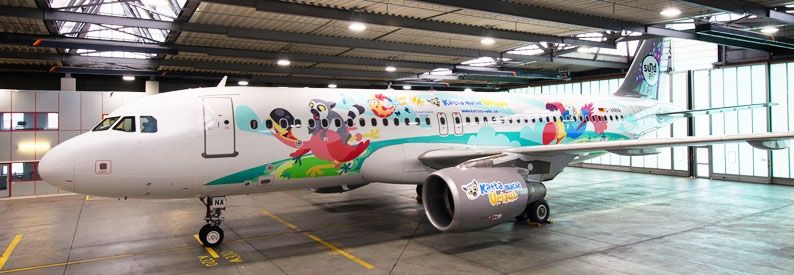
Qatar Airways has grounded 13 Airbus A350s due to surface issues (not pictured). Photo: Vincenzo Pace – Simple Flying
The Airbus A350 is a key part of the Qatar Airways fleet. However, recently the airline’s CEO, Akbar Al Baker, has had particularly strong words about the fleet, going as far as to stop further A350 deliveries. Now, the airline has taken the decision to ground 13 of its fleet of A350 aircraft.
What’s the issue?
According to Qatar Airways, 13 of its Airbus A350 aircraft have suffered accelerated surface degradation below the paint scheme. The Airbus A350 has a composite fuselage as opposed to the traditional aluminum fuselage of older aircraft.
According to Qatar Airways, it has been working closely with the Qatari aviation regulator regarding the aircraft. The regulator has now issued ‘explicit written instructions’ to ground the 13 aircraft affected by the issue. The aircraft will remain grounded until the cause of the degradation has been established, and a permanent fix has been made possible.
The story seems to have started back in November 2020. Back then, the airline sent a four-year-old Airbus A350-900 to Shannon in Ireland. The IAC paint shop was due to apply a livery celebrating next year’s football world cup in Qatar.
When the paint was stripped off, the paint shop reportedly found cracks in the aircraft surface, though Airbus later clarified that these were “superficial/cosmetic and only visible when the top coat of paint is stripped”.
In early January the aircraft was ferried across to Toulouse without a paint scheme applied so that it could undergo further examination. The aircraft has remained in Toulouse since, and it seems as though this is what has been observed on the other 12 aircraft too.
Qatar Airways says regulator grounds 13 of its Airbus A350s over surface issue
DUBAI, Aug 5 (Reuters) - Qatar Airways said on Thursday it has grounded 13 of its Airbus (AIR.PA) A350 jets at the instruction of Qatar's aviation regulator due to the surface below the paint deteriorating faster than expected.
The state-owned carrier has fallen out with the European planemaker over the dispute, having said earlier this year it would not take A350 deliveries until the problem was fixed.
"With this latest development, we sincerely expect that Airbus treats this matter with the proper attention that it requires," Qatar Airways Chief Executive Akbar Al Baker said in a statement.
50 Aircraft And Counting: Viva Aerobus Continues Fleet Expansion
This week, the Mexican low-cost operator Viva Aerobus received its 50th aircraft, an Airbus A321neo, registration XA-VBM. The new airplane is part of Viva Aerobus’ plans to nearly double its fleet in the next five to six years. Let’s investigate their plans further.
Viva Aerobus received its 50th plane earlier this week. Photo: Viva Aerobus
The new plane
On July 31, 2021, Viva Aerobus took delivery of the A321neo, registration XA-VBM. The plane came directly from Hamburg, Germany, with stopovers in Keflavik, Iceland, and Bangor, United States.
Juan Carlos Zuazua, Viva Aerobus CEO, said,
“The arrival of our fiftieth plane is a symbol of the compromise we have with affordable air connectivity in Mexico. It is also an acknowledgment of our ultra-low-cost business model and our fleet expansion plan.”
This A321neo has a capacity for 240 passengers and will allow Viva Aerobus continuous growth for the next few years. So far, the low-cost airline has carried 6.4 million passengers, a 19.39% growth compared with 2019 levels. It has also posted a minimal first-half profit, coming back to the black following the COVID-19 pandemic crisis.
Viva Aerobus will get 40 more planes in the next five years. Photo: Getty Images
More A320 aircraft coming up
Currently, Viva Aerobus has a fleet of 50 aircraft and an average age of 4.4 years. This means Viva has the most modern fleet in Mexico and the second in North America.
The Mexican carrier expects to increase the number of airplanes it has in the following years.
According to Juan Carlos Zuazua, Viva Aerobus will receive up to 40 new planes in the next five to six years. If the airline doesn’t retire any older airplanes, it could have up to 90 jets by 2026. According to ch-aviation, Viva’s A320 and A321ceo fleets are 7.7 and 7.6 years old.
The company stated,
“This fleet expansion plan brings the carrier the necessary backup to deal with the growing demand it has had recently, even in the midst of a challenging environment worldwide. Viva Aerobus is leading the sector recovery, surpassing its pre-pandemic passenger levels.”
New routes, to where?
Despite the COVID-19 pandemic, Viva Aerobus has been growing. The Mexican low-cost carrier closed 2021’s second-quarter operating 133 routes. It has 104 domestic flights and 29 international.
During the first half of 2021, Viva Aerobus launched ten new routes, including five international. It started operations between San José del Cabo and Cincinnati; El Bajío and Houston; El Bajío and San Antonio; Harlem and Monterrey, and Bogotá-Mexico City.
But the carrier isn’t quite done yet. Viva Aerobus plans to continue growing both domestically and internationally.
In Mexico, there’s still a gap left by Interjet, so the domestic airlines are still developing new routes to fill it.
Abroad, Viva Aerobus faces the challenge of not being able to grow into the United States. Mexico currently has a Category 2 safety rating by the Federal Aviation Administration, meaning Viva Aerobus and other Mexican airlines can’t add new routes, frequencies, and planes into this country.
Nevertheless, Zuazua left open the question that Viva may launch new flights to North America, Central, and South America. Some of these new routes could open up in January 2022, so it will be interesting to follow Viva’s developments.
Frontier Airlines has recorded a slim second-quarter net profit of $19 million. Though not quite back to pre-pandemic profitability and benefiting from government support, Frontier Airlines is starting to look beyond the crisis. The carrier has signed a letter of intent to take on ten additional Airbus A321ceo aircraft.
Frontier Airlines has announced it intends to acquire ten additional Airbus A321ceos. Photo: Airbus
Frontier reports a net profit
For the second quarter of 2021, Frontier Airlines reported a net income of $19 million. This compares to a $17 million net income reported in the second quarter of 2020 and a $72 million net income in the same quarter of 2019. This profit includes $87 million in government support received by the airline in the quarter.
This year, during the quarter running from April through June, the airline recorded passenger revenue of $536 million as leisure travelers booked their summer plans and paid heavily for ancillary fees. The carrier recorded approximately $60 of ancillary revenue per passenger, which was 6.1% higher than the same metric during the second quarter of 2019.
As of June 30th, the airline had $936 million in unrestricted cash and cash equivalents. Given the substantial increase in demand and strong continuing trends, the airline allowed its loan facility with the US Treasury Department to lapse. It will now focus on repaying the $150 million outstanding Treasury Loan to unencumber the airline’s co-branded credit card program and related brand assets that serve as collateral for that transaction.
Frontier Airlines to take on ten more aircraft
In July, Frontier Airlines signed a letter of intent with two of its leasing partners. Through direct leases, the carrier will bring on ten additional Airbus A321ceo aircraft. The deliveries are expected to begin in the second half of 2022 and continue into the first half of 2023. These incremental aircraft will allow the airline to boost its capacity growth rate amid the ongoing recovery.
One of the big boosts the new aircraft will provide is more seats per departure. James Dempsey, EVP and Chief Financial Officer at Frontier Airlines, stated the following on the carrier’s second-quarter earnings call about the incremental aircraft:
“Our average seats per departure from today’s announcement, for example – that we added 10 aircraft – our average seats per departure in 2023 will go to just over 200 seats. I mean that’s really positive from a unit cost perspective in the business, and it actually opens up opportunities for us, and destinations around the United States that we think are interesting.”
We’ve deployed our current fleet of A321s, for example, accross most of our network. We’ve tried it in various markets. They work in big markets, they work in small markets, they bring lower unit cost. The marginal costs on the extra seats is very low. We believe we can successfully deploy the additional A321s in almost every airport in our system. There are a few airports where, operationally, we have to use 320. But, broadly speaking, the 321 can fly almost everywhere in our system and as a mix of our fleet continues to move towards the 321, you’ll see us deploying it system wide.”
Frontier’s A321 fleet is quite young. It only received its first of the type in 2015. Photo: Airbus
Frontier’s fleet plans
Five more Airbus A320neos are set to join Frontier’s fleet in the third quarter of 2021, rounding out deliveries for this year. Next year, it will take nine A320neos and five A321neos. Then, in 2023 and 2024, it will take 19 A321neos each year.
Couple this with the ten Airbus A321ceos set to join the Frontier fleet, then by the end of 2023, the airline will have 34 additional higher gauge aircraft in its fleet compared to the end of 2020. The airline also accelerated the drawdown of its Airbus A319 fleet.
Frontier typically targets peak-day flying only a few times per week between cities in a largely point-to-point fashion. While other carriers may come into markets with daily or more frequencies, Frontier would rather fly leisure passengers on larger aircraft on specific days than flying smaller aircraft once per day.
From an economics point of view, there is a lot of promise for Frontier’s A321ceos and A321neos in the fleet. Barry Biffle, the CEO of Frontier Airlines, stated that the airline plans to hit ancillary revenue per passenger of $63 come 2023. This enables Frontier to have a breakeven fare of about $30, which means the airline has a lot of power to do price stimulation.
Where other airlines have higher cost structures and limited abilities to earn ancillary revenues, Frontier sells a completely unbundled product and tries to coax passengers to get onboard an aircraft with low fares and then sells them ancillary options to enhance their travel experience to turn a profit.
One interesting move from Frontier could be to convert 18 A320neo orders into A321XLR firm orders. Photo: Airbus
With a breakeven fare of $30, this means Frontier can run even lower fares in more markets and then aggressively market its ancillary options. Even with adding $63 in ancillary options, $93 is generally a pretty decent one-way fare for most travel in the United States.
The Airbus A321s are going to be a significant part of Frontier’s growth strategy. It is also worth noting that Frontier has the option to convert 18 A320neo aircraft to A321XLR jets. Frontier has not acted on those conversion rights, but if it chooses to move in that direction and exercise those rights, it will certainly further its mission of flying higher gauge aircraft across its network.
9A-CTN (msn 5085) was ferried from Zagreb to Leipzig/Halle on July 23, 2021, and began revenue operations for the German leisure specialist the next day. It remains based out of Leipzig and is deployed to various leisure destinations in southern Europe and northern Africa.
The contract has provisionally been signed through August 19 but may be extended through the end of August, both carriers confirmed.
PLAY Set To Take Delivery Of Its 3rd Airbus A321neo
PLAY is gearing up to receive its third A321neo later this week. The aircraft, another former Interjet plane, has emerged from the paint shop in Texas, ready to be ferried to Iceland on Thursday. That brings the startup airline’s fleet to three A321neos, giving it the opportunity to bolster capacity for the rest of the summer season.
PLAY’s third A321neo is ready for delivery. Photo: PLAY
Three for PLAY
Iceland’s newest airline is gearing up to add more capacity to its fleet this week, as its third A320neo is ready for delivery. The plane was pictured leaving the paint shop in Texas, ahead of its delivery to Iceland on Thursday.
The A321neo will be registered TF-PLB once PLAY takes delivery. It is a 3.3-year-old aircraft, originally delivered to Interjet in 2018 as XA-NEO. Both PLAY’s existing A321neos were former Interjet aircraft too, and all have the same rather generous 192 seat all-economy configuration.
According to data from RadarBox.com, the aircraft was stored in Arizona for much of the previous 12 months. 10 days ago, it was ferried to Amarillo, Texas, for painting. International Aerospace Coatings (IAC) took care of the neo’s new gleaming coat of paint.
The neo had a shiny new coat of paint ahead of its long flight to Iceland. Photo: PLAY
The addition of another neo for PLAY will help the airline to ramp up its capacity for the remainder of the summer season. From just 130 flights in July, PLAY will operate 198 in August, keeping things at that level through to October. From November to March, capacity will hover around 160 – 170 flights per month.
Where has PLAY been flying so far?
PLAY launched as a new startup to much fanfare at the end of June. Its inaugural destination was London Stansted, but more connections quickly followed. By the end of July, it had added Tenerife, Copenhagen, Paris, Berlin, Barcelona and Alicante to its route map.
For August, the airline is scheduled to fly to all those destinations but with increased capacity. The airports getting the most PLAY love are Stansted, Copenhagen, Paris and Berlin, all with 18 flights for the month. Barcelona, Tenerife and Alicante stick at around eight or nine flights.
Copenhagen is getting lots of PLAY love. Photo: PLAY
No new destinations are loaded into the schedule until December when we see it operating a one-off flight to Warsaw, as well as two rotations to Gran Canaria. January sees the addition of Saltsburg, with a couple of rotations a month to start, while Gran Canaria sees increasing numbers of flights as we move into 2022.
Barcelona will see its last flight at the end of October. This seasonal service will return in summer 2022. As yet, no transatlantic flights are loaded in, but we can hope to get more news on that later in the year as PLAY increases its fleet size and lays out its plans for next summer.
Qatar Airways Has Removed Most Of Its Airbus A330-300s From Storage
Over the past month or so, Qatar Airways has been steadily removing its Airbus A330-300 fleet from storage. The entire fleet has now been relocated from Doha International Airport to Hamad International Airport, with five out of eight aircraft already operating cargo and passenger flights.
Qatar Airways is in the process of reactivating its Airbus A330-300 fleet. Photo: Qatar Airways
While Qatar Airways was the only of the Middle East giants to keep flying passengers around the globe at the height of the pandemic, it didn’t keep its entire fleet operational. Many were shuttled to Doha International Airport for long-term storage, with some, such as the Airbus A380 fleet, unlikely to even return to service.
Five of eight back in service
According to fleet data from ch-aviation.com, Qatar Airways has eight Airbus A330-330 aircraft. The oldest is A7-AED which is 16.03 years old. Meanwhile, the youngest, A7-AEO, is only 13.42 years old. The aircraft had been in storage at the old Doha International Airport.
According to flight data from RadarBox.com, the airline has moved all eight of the aircraft the four-mile as the crow flies journey from Doha International Airport to Hamad International Airport. Unfortunately, the A330 doesn’t fly as the crow flies, meaning that the journey instead took a quarter of an hour.
All of the aircraft have made the short hop from Doha International to Hamad International. Photo: RadarBox.com
The first A330-300 returned to service on July 1st. They hadn’t flown since July 1st, 2020, with the last commercial flight operating from Chennai. It seems the A330-200 fleet could be following suit. A7-ACI flew to Brussels on August 1st, following its removal from storage. It seems one of the airline’s former A330-200s won’t be flying again, having been sent to Air Italy and then the desert.
The data available shows that five of these aircraft have so far returned to service. Given the flight numbers in use by the aircraft, QR8—, it appears that the planes are primarily being used for their cargo capacity on preighter flights. Despite this, ch-aviation.com did suggest that the aircraft was being used for passengers from London Heathrow Airport (LHR) in place of the Boeing 777-300ER.
Three aircraft still not active
Three of the Airbus A330-300 aircraft remain inactive for the time being. These include A7-AEE, A7-AEG, and A7-AEO. EE and EO have so far only been ferried across to Hamad International Airport. Meanwhile, it seems A7-AEG has already taken a big day out, albeit without getting very far.
According to data from RadarBox.com, this aircraft was ferried across to Hamad International Airport on April 23rd, taking 14 minutes. The plane remained on the ground until June 9th, then it completed a test flight above the sea adjacent to Qatar. During two and a quarter hours of flight, the aircraft reached a max height of 40,000 feet. The aircraft remained in the local area, completing a touch and go before returning to land at Hamad International Airport.